Category Archives: UCP Series

UNCONVENTIONAL CITY PLANNERS: PART 3 [SEVEN ARTS CITY, CALIFORNIA]

In the Unconventional City Planners series, Mackenna Caughron explores three unconventional planners and their machinations of the city. This is the final part of the 3 part series.

Mackenna Caughron [Source]

Few humans on Earth can claim ownership over our ideals and imaginations more so than Walt Disney. A staunch businessman, ardent innovator, and frequent risk-taker, Walt Disney launched an empire of escapism, stealing us from reality through film, products, and parks. Americans largely give Disney real estate in their private spaces, a brain-boosting reminder each time we hug our plush Simba, don a Stormtrooper sweatshirt, or deliver a pitch-perfect rendition of “Let it Go” (I recommend one’s car to closely mirror the vocal talents of Idina Menzel).

Disney’s foray into the tangible – Walt Disney World – has been lauded as the “most imaginative piece of urban planning in America” (though the California’s Disney Land is the only amusement park that Walt Disney lived to see open, Florida’s Disney World opened 5 years after his death).

Disney’s prowess in the surreal is undeniable. Disney’s sugary sweet fantastical Americana shakes Disney visitors into a nostalgic glow, one that demands a price of over $550 per day for a family of four (before hotels, flights, confectionary treats, Fast Passes, and souvenir glitter Minnie Mouse ears).

Not surprisingly, Disney yearned to build a “real” world as well. He briefly and incompletely planned the construction of an actual city, one where visitors were not expected to wear character paraphernalia.

What happens when the dreamer meets reality? Seven Arts City. What began as an ambitious partnership with California Institute of the Arts, the Seven Arts City sought – like its brother fantasy theme parks – to inspire. Though the real world prevented the city from taking flight.

Digital Collections of the Los Angeles Library. [Source]

Location of Seven Arts City

Where else would a real Disney-city be other than California? Even more fitting, the site acted as a famed backdrop of several Disney films. The bucolic Golden Oaks Ranch sits a 30 minutes (no traffic) drive from Los Angeles’ downtown core, in Santa Clarita, California.

Its commercial history began in 1842 as the site of California’s first gold strike (though this is somewhat contested, as myths often are – it still made its way into the promotional brochure for Seven Arts City).

The forested, sunny setting of Golden Oaks Ranch. [Source]

Walt Disney encountered the property nearly a century later, when he leased the ranch to shoot scenes for the Mickey Mouse Club. “The Ranch” continued to play backdrop to several features and television shows. Entertainment executives desired Golden Oaks’ varied nature (waterfalls, forest, mountains) within its 900 acres.

The Santa Clarita location was carefully chosen for its “beauty, accessibility, and growth potential“.

It was in this bucolic setting of Hollywood’s old wild West, where Walt Disney dreamt of an arts mecca for the everyday person.

Urban Experience

Despite its ambition to become a global attraction, Seven Arts City would not solely entertain. The merger of the Chouinard Art Institute and Los Angeles Conservatory of Music (“CalArts”) emboldened its design – why not create a dual-purpose campus, creative center, and…. destination (I mean, it is Disney, after all, he had to find a profit-inducing angle).

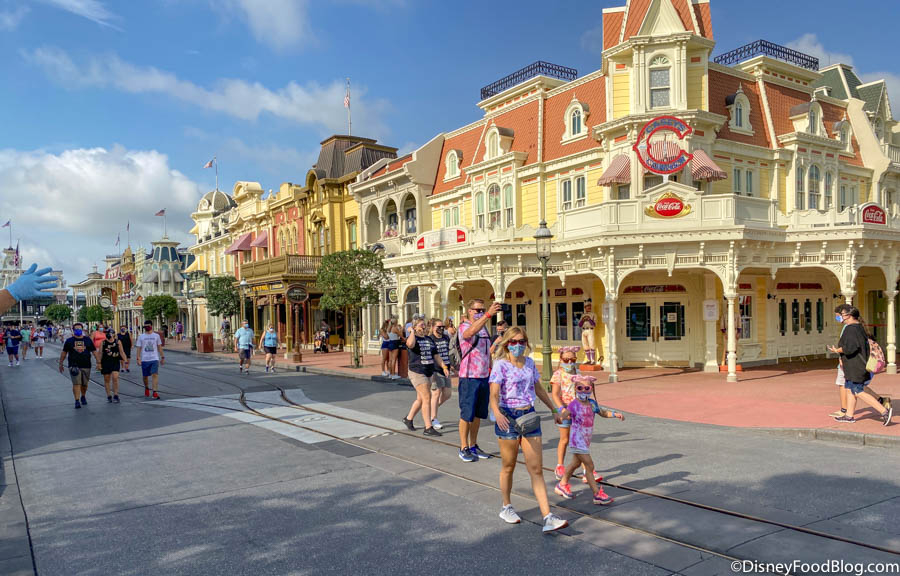
A magical place, where pedestrians are prioritized over vehicles… Not Europe, Disneyland (Main Street, U.S.A.). [Source]

The campus would be centered around a large hub, one that would support “classrooms… studios…. [orchestral and opera] practice rooms” surrounded by a lush landscape that the architect professed would “harmonize with the terrain… to be reminiscent of ancient Greece“.

Unlike Disney’s parks, Seven Arts City would house a hivemind of 1,200 students representing diverse artistic skill sets – film, music, paint, dance, fashion, sculpture, theater – all working together on experimental projects that would push against convention. Residences would sit in suburb-like rows, next door to the central hub within comfortable walking distance.

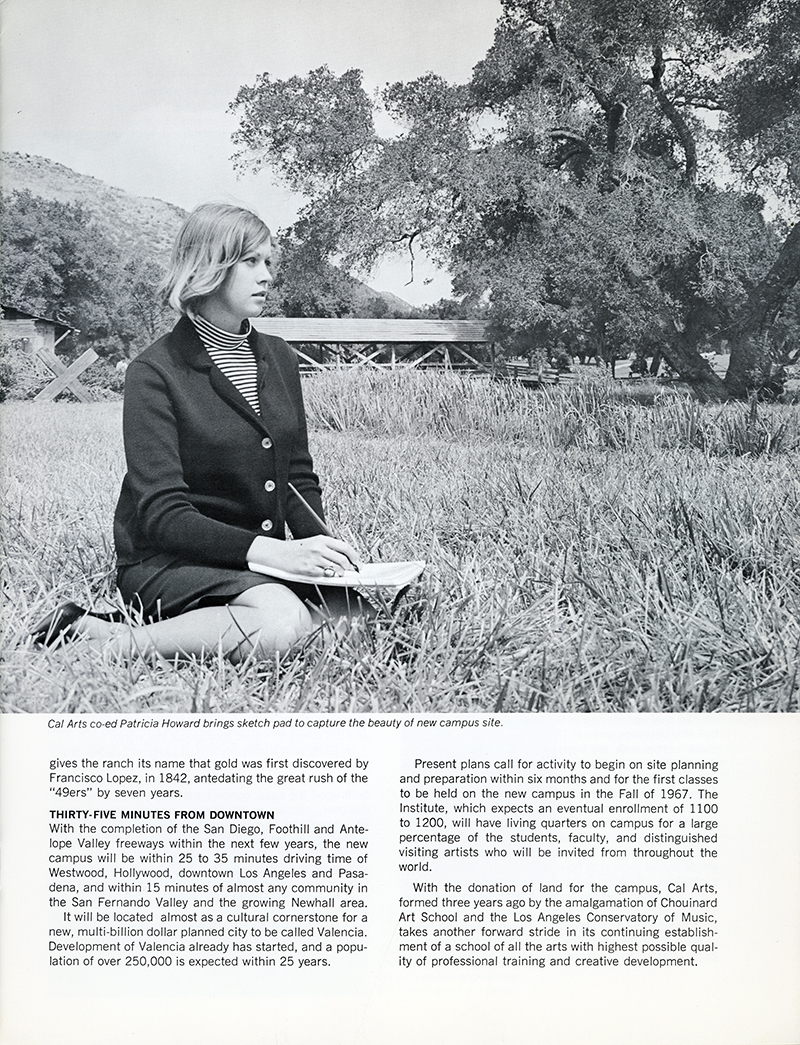
A CalArts student sits in the grass of the proposed site at Golden Oaks Ranch. [Source]

In addition to an erudite student body, the campus would “collect in one place the great art treasures of all time in reproduction so scientifically exact as to be indistinguishable from the originals”, according to Disney. 

Though Golden Oaks Ranch consisted of 700+ acres at the time of the city’s planning, only a subsection – 38 acres – were deeded to CalArts. Roughly the size of Central Park’s Ramble, the Seven Arts City would feel cozy, familial, and right-sized – just like a Disney theme park. Its internal veins would be foot-traffic friendly, though the city would remain accessible via the newly completed San Diego, Antelope Valley, and Foothill freeways, serving California’s car-owning population.

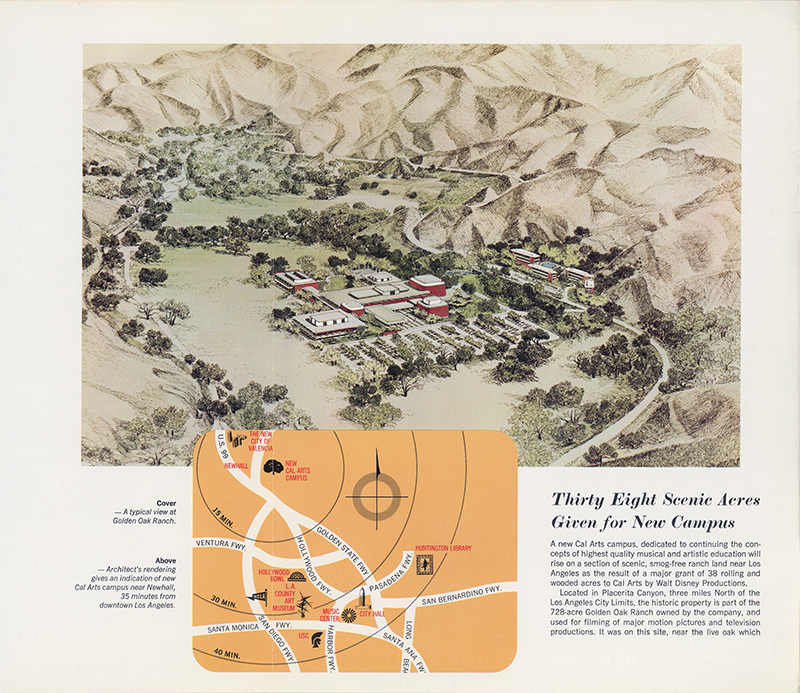
An early artist’s rendition of Seven Arts City [Source]


Challenges

One year after its big promotional push, Seven Arts City lost its visionary “John Hammond” when Disney died suddenly. Without its crucial financial and starry-eyed supporter, the project shifted from its original grandiosity. 

Details remain murky on the specifics of Disney’s intended artistic paradise. Wolf Burchard, museum curator at the Metropolitan Museum of Art acknowledged, “No visual material [exists to] illustrate what [Seven Arts City] would have looked like…” 

The drawings in promotional materials remain artistic and lack needed clarity. Disney – especially as he progressed in his career – operated at a distance from the details. Without his oversight, the plan fizzled. Even the Golden Oaks Ranch site eventually proved unstable due to unforeseen geological forces.

The idea of Seven Arts City became the eventual permanent campus of CalArts in Valencia. Particulars of the original plan persisted, including a main building as the central organ and an academic ideology of interwoven arts. Most importantly, the CalArts institution carries on, and remains to this day a fine choice for burgeoning arts students.

Though the grandeur of a mecca, one for the artist and art-curious alike, faded.


What do we take away?

Both in form and feel, Seven Arts City would be the functional embodiment of “gesamtkunstwerk“, a concept coined by composer Richard Wagner. The term criticized the slicing of the opera, but later inspired a movement to unify all arts (gesamtkunstwerk translating to “total arts”). As has been astutely observed, Disney mirrored the union of arts in his famed medium: animation, music, and film. But he also sought it in his tactical experiences.

 Disney at the helm of the city still had a creator’s eye. Undeterred with the details, he was still watching one aspect of the creative process. As Robin Allan described in his biography of Disney, though he “became increasingly uninvolved in the actual animation work, his contribution extended from what his employees described as his consummate ‘storytelling’…”

 Disney loved the awe of an arc. So much so, he templatized his process (and many others have documented his winning formula). Seven Arts City was no exception. Disney promoted the powerful narrative of an experimental, innovative center in the backdrop of northern Los Angeles. And everyone bought a ticket.

 More compelling, the decision to market the idea as a destination for students and visitors alike brings both population segments to the city. Students wishing to share experimental work will benefit from visitors wishing to see world-class visual stimuli. The awe, inspiration, and excitement feels familiar. Maybe like how one feels at Disney World?

 Disney – consciously or not – idealized Seven Arts City with respect to sensory stimuli and emotional states. And this effort is consistent with his overarching career. Journalism scholar Josef Chytry argued that “Disney’s objectives should be seen largely with regard to certain specific emotional results – optimism, contentment, excitement, happiness…” He attaches his work to feeling.


Disney (now as a company, formerly the person) creates these “emotional environments” in film, parks, and products. Childhood wonder and curiosity are promulgated without term limits. Where Akon City and Starbase fill a gap or address a problem (economic disenfranchisement in Africa and Earthly climate instability, respectively), Disney seeks to evoke feeling as a primary outcome. But note, all of our unconventional planners look to blank canvases to design their dreams. No one is interested in bending our current predicaments toward progress.

 Planners rarely are afforded the luxury of dealing in the surreal. Most inherit existing infrastructure, residents, economic pitfalls, and barriers to development. Though there are lessons in each of the unconventional planners.

Akon City sought to nourish.

Starbase sought to give foundation.

Seven Arts City sought laughter.

And all of these objectives are worthy pursuits of our city, however frivolous and problematic. So when we plan our cities, we should do so with unconventional planners in mind. While flawed at times in execution, they reach. They inspire. And when our cities cease to dream, so do its residents.

Unconventional City Planners: Part 2 [Starbase, Texas]

In the Unconventional City Planners series, Mackenna Caughron will explore three unconventional planners and their machinations of the city. This is part 2 of a 3 part series.

I remember first seeing Robert Downey Jr. as Tony Stark in Iron Man. He was brash, confident, techno-intelligent, and liberal spender. The exemplar of “making it” with a specific American flair of “I say and I do what I want”.

Source: Mackenna Caughron

As headlines sour and the pressing issues of the day weigh on our minds, we look for a fanatical zealot to save us. Though not an Iron Man replica, we have a modern day rocketman in-training. Elon Musk, TIME’s 2021 Person of the Year, CEO, Chief Engineer, investor, prolific Tweeter, our savior (?), and city planner (???). Well, we’ll see.

Looking west on Esperson St in Boca Chica Village, Starbase visible in the background. GoogleMaps.


Hard to deny a certain resemblance… (Source – Here & Here

Where do our two male leads differ? Iron Man rescued our galaxy, Elon is looking to colonize it.

Elon Musk operates SpaceX, a private, for-profit company aiming to build reusable rockets to shuttle humans to Mars and other planets. Though Elon Musk’s multi-planetary plans are well-documented, it is a little town in Texas that we will be exploring today. Starbase, Texas – the launchpad for interstellar living.

Location of Starbase

Teetering on the edge of the United States sits SpaceX’s Starbase tracking station.

Google Map Location of Starbase, TX

Elon Musk announced his hunt for a commercial space launch site in 2011. He courted Georgia, Puerto Rico, and Florida, before ultimately choosing Texas after publicizing his $15M in financial incentives and meeting with the state’s governor.

The site benefits from the Earth’s west-to-east rotation. A “fat” location on Earth rotates at a higher velocity angular momentum push (similar to why Cape Canaveral, Florida is NASA’s launch HQ). 

The coastal location had an eclectic fan club. Allegedly once dubbed “the next Ft. Lauderdale”, the hurricane-prone settlement dwindled to 6 permanent residents, according to a Texas Ghost Town feature dated 2008. The town, officially named Boca Chica Village, still has non-potable water trucked in and lackluster cell reception, but that did not bother long-time residents.

Looking west on Esperson St in Boca Chica Village, Starbase visible in the background. GoogleMaps.

The area is quaint. Single-story homes dot the perimeter of the $100M launch facility. The only restaurant in town “The Prancing Pony Bar and Grill” exclusively serves SpaceX employees (the restaurant lacks any online presence albeit Google user uploaded photos). 

Inside the Prancing Pony Bar & Grill, you can find the “Occupy Mars” sign, publicized thanks to Google users.

This is the site of the Prancing Pony Bar & Grill. Google Maps captured this area in April 2011, far before development began. It is fitting that a lonely “for sale” dots the foreground, a sign of things to come. Google Maps.

Brownsville is the nearest city. A 30-minute drive west on the Mexican border, Brownsville suffers from America’s highest urban poverty levels (34% in 2013), experienced by a dominant Hispanic population (88% In 2013). 

Elon Musk sees this sleepy rural zone with nearby impoverished populations and sees our gateway to salvation. 

Urban Experience

Elon Musk has not contracted a questionably named consulting company ala Akon City, however, we can analyze his historical actions and early perspective in interviews.

Starbase, Texas will send individuals to the moon, Mars, and beyond.

What kind of people would one meet? Residents may work for SpaceX (or supporting businesses). Tourists who time their visits to catch a launch. Ticket-carrying customers preparing to depart to worlds beyond, maybe grabbing the last of their favorite Earthly items (Avocados? Sneakers?) taking flight. The rhythm of the city gravitates around the launch schedule. Its economy depends on it.

Like the surrounding neighborhoods of a traditional airport, the port of Starbase will house employees (and their exclusive Lord of the Rings-hinting restaurant), interstellar tourists, space enthusiasts, and residents.

 Currently, facilities are relegated into the manufacturing, testing, and launching of Super Heavy and Starship prototypes. Inherent risk – and fanfare – is possible within the operations of the city, akin to living near an industrial zone.

 Starbase planners may look to Cape Canaveral, NASA’s home to the Kennedy Space Center for inspiration. With a handful of launches each month, Cape Canaveral acts as a space-themed amusement park. Neighboring Disneyworld, the Florida city’s main draw is the NASA’s Kennedy Space Center and rocket launch viewing areas (Sorry, Manatee protection areas, your days are numbered).

Major intersection in Cape Canaveral, Google Maps. 

Florida’s “space coast” offers some lessons. It has a wide variety of civic initiatives including a community-led re-visioning project, sustainability and resilience initiatives, parks, and beaches. Elon Musk would lose valuable funding if he foregoes a tourist-leaning, revenue generating example

The Las Vegas Convention Loop system is designed for 4,400 passengers per hour [Source].

Elon Musk may deploy other companies he’s spun up to address city stressors. His cheekily named “The Boring Company” pilots subterranean tunnels for freight, transport, and utility. Musk may leverage Tesla and TBC’s capabilities to construct a hyperloop.

Traveling through the city, you’ll see Elon Musk’s inner engineer fingerprinted within the city’s logistics and operations. In a manner less showy than Akon City, the city’s father will calibrate his vision of an efficient, low waste hub.

Purpose

Why travel to Starbase? Well, it’s all in the name. A base for the stars. Thoroughfare to galaxies far, far away. But also a testing ground where technology is (explosively – at times) being developed.

It raises interesting questions how the city should be structured, for humans flourishing or scientific experimentation, and whether both needs can be met harmoniously. 

Challenges

It’s clear current Boca Chica Village residents are not part of the plan. SpaceX offered their “best and final” to the small group of existing homeowners that had not yet sold their homes to the ambitious company. When the homeowners resisted, the company suggested the use of “alternate approaches” to obtain the land. It is unlikely that county or state governance would take issue with the seizure tactics. Musk specifically has been shifting businesses to Texas due to an alignment toward a more lenient approach to governance (more on that in a bit).

 And it makes sense. Airports as they exist today do not conduct high quality of life. Studies have shown deteriorating health caused by increased noise and pollution exposure. Starbase already expects residents to evacuate the launch area, pushing people from their homes and inciting local ire. A rocket with the name of Superheavy is not likely to be light on the ears, despite achieving some pollution benefits through Musk’s design objective of reusability.

 Even the closest success case of Cape Canaveral may be tough to replicate. The Florida space coast has a population of dominantly white, older homeowners (93.8% white non-Hispanic, 35.8% older than 65, 10% poverty rate).

 In contrast, Brownsville, the closest urban center to Starbase, is 18 times more populous, skewing younger with higher levels of poverty. In a certain and sad realization, their lives may be easier to “re-engineer” given traditional economic and social power dynamics. Shifting the economics toward amusement or science may disrupt or displace these lives. For those who have already spoken up, the response is quick.

What do we take away?

Elon has spoken to the fatality of Earth. He doesn’t see the longevity in Earth being a forever-sustaining home for our species. To save humanity, we have to build transport vehicles that will take us to other, more suitable homes.

 It’s an admirable cause – to save the human race. Not dissimilar to Tony Stark’s Iron Man, looking to rid the planet of evil aliens, bent on destruction. Though, Musk sees our planet’s destruction as inevitable, and thus – perhaps not salvageable.

 In traveling to our next planet, he’s also discussed an entire new form of organization. He’s recommended reshaping the government, perhaps a direct democracy with laws simple enough to avoid coercion of powerful stakeholders. Radical transparency, with a well-informed populace, and fewer rules and regulations (we can see why Texas again is so appealing).

 And for an individual hell-bent on reusing materials, he’s ready to find a brand-new foundation for life.

 Similar to Akon, we see Elon’s perspective of the future shaped in his city. Whereas Akon emphasizes the visuals in an attempt to form ultra-luxe Cosmopolitan African Wakanda; Elon values the processes and experimentation of those processes. They both see blank slates as valuable, open canvases for their imagination. The danger in that? When we are planning so far for our future generations, we forget the 186,000 people that currently live in Brownsville.

Unconventional City Planners: Part 1 – Akon City

In the Unconventional City Planners series, Mackenna Caughron will explore three unconventional planners and their machinations of the city. This is part 1 of a 3 part series.

Mackenna Caughron [Source]


Raised in Senegal and New Jersey. Investor in solar energy. Son of a professor/musician and a dancer. He reminisced on his upbringing, “I was that kid you see on National Geographic with no shoes on” (8:55). 

Grammy-nominated songwriter of “Smack Dat” and “I Wanna Love You”.

And yes, an urban planner (of sorts).

Aliaune Damala Badara Akon Thiam, known in popular culture as “Akon” exploded our musical zeitgeist in 2004. Since the release of his debut album “Trouble”, he’s received multiple RIAA accolades, filmed sultry music videos, and shaped the beat blasting in clubs worldwide.

Yet, with this success, we see discomfort. “One of my biggest fears was just being known for singing and dancing.” he noted. Throughout interviews, he acknowledges a desire to use his wealth to uplift Africa.

Ten years after releasing his first album. Akon co-founded Akon Lighting Africa, which sought to provide sustainable energy for communities in Africa. The program spread to 14 countries to 480 communities funded through a $1B line of credit from Chinese and other international firms (its website sits dormant and its https://twitter.com/akonlighting?lang=en, so it’s unclear if the project is presently active). 

Akon continued to enjoy his musical career, though something changed in 2018. Akon sat down to watch a movie, and left with an idea. The Marvel superhero movie Black Panther featured a dazzling cast – Chadwick Boseman, Michael B. Jordan, Lupita Nyongo’o. Despite laudatory performances by the film’s actors, it was the setting of Wakanda, the futuristic, techno-centric, coveted African city, that stole the show.

Wakanda – Credit: ©Walt Disney Co. / courtesy Everett / Everett Collection

Akon pulled together a team. On the coast of the North Atlantic Ocean, he announced “Akon City” – the not-yet-built development project with a $6B price tag. After examining the city’s publicly available plans and objectives, what can we learn from this city planner best known for a music career?


Location of Akon City

By 2024, Phase 1 of Akon City will sit on 2,000 acres – roughly 60 miles from Senegal’s capital of Dakar, one hour from a newly built international airport.

Location of Akon City – Source: Google

The area is fairly sparse in terms of urban development. Looking at the site from the nearest highway, the setting is bucolic. Akon envisions a dramatic transition to retrofit the area for his planned grandeur.

Current Road Conditions – Source: Google

Urban Experience

Stepping into Akon City will land visitors into a scene from Star Wars, another entity under the Disney umbrella. 

The city will combine buildings, paths, parks, and roads – not surprising. When walking through the city, individuals will notice open parks adorned with local fauna. Amorphous buildings rising to impressive heights, inspired nearby waves of the Atlantic, will draw the eye up. You’ll see students, doctors, tourists, locals, and even celebrities (beyond Akon, even). At the cashier, we won’t reach for our wallet, but instead our phone to pay with Akoin.

For experiencing the city by car, a “smart” parking system awaits, with a focus on “e-parking, automated parking system[s], e-transportation“. Though the city is approximately 2.5x the size of Central Park, the plan knits the city’s functions into districts, promoting walkability.

Akon City [Source]

Within each of the city districts, Akon channels his aspirations.

The Technology District intends to spark local economies with skilled jobs and to attract global capital. The Entertainment District showcases a resort/spa, mall, casino and sport stadium with Olympic aspirations. The “African Culture Village” delivers luxury hospitality experiences to spur a competitive tourism sector. An Education Hub, Health and Safety district, and scattered Offices and Residential buildings cater toward a burgeoning professional job sector. Last and certainly not least, Akon City houses “Senewood”, a cheeky wink to Hollywood. Senewood will house film, music, and television studios.

In navigating the city, lost individuals can look toward the city’s tallest building, appropriately named “Akon Tower”, standing at 68 stories tall. Its contents are a hallmark of its maker, combining a recording studio, club, hotel, and office space. Akon Tower will ground directionality into the city, akin to looking south to the World Trade Center and north to the Empire State Building.

Akon Tower [Source]


Purpose

The intent of Akon City is part-thriving metropolis, part-campaign for its creator. Akon City location promoted its tourism ambitions with an oceanfront proximity to the airport. Local politicians have applauded  the idea, giving the land to Akon with a specialized tax designation. Tourism attempts to create economic viability through its draw of people and financial capital.

Though, the city serves another purpose, a physically built testing ground for Akon’s cryptocurrency, Akoin. Cryptocurrency generally gained a foothold in African countries, and Akon is betting that the continent (who has the world’s youngest continental population – 70% of individuals under 30) will benefit from his financial system in opposition to volatile local currencies.

Akon City heaves forward with the dreams of its creator and a nation. Is the weight of imagination too much to carry?

Challenges

The early ideation of Akon City was met with criticism. 

From the initial creative reveal, Akon City faced pushback over hiring international partners for development. A Dubai-based firm “BadConsult” (which, can we all agree, probably not the best name for an architectural design firm) created the renderings of the city, which were panned, namely for not drawing local inspiration or acknowledging Senegal’s climate realities. KE International, an American engineering and consulting firm, secured the first $4B in funding and will construct Phase 1, which also drew ire as the selection – once again – is international.

In researching Akon City, publicly-available details seem… vague. The Akon City website has broken links and lofty platitudes, and plants the question, this is all great – but how? And who is this for?

This section on Akon City’s website landing page promotes a basic description of IoT. When clicking “KNOW MORE”, the browser is given a 404 error – which may be a subtle and unintended commentary on the depth of the project’s plans. (As well, noted the “I’m allergic to basic” t-shirt.) 

And really, who is this city for? Akon claims the city is for everyone “from janitors to engineers…” and a portion of housing (30%) would be affordable to “the lower half of the wage market” (in 2020, Senegal’s GNI per capita was $1,430 or $3.92 per day). Tourism is a primary function of the metropolis. The project’s co-developer (the Society for the Development and Promotion of Senegal Coasts and Tourist Zone or SAPCO, Senegal’s state tourism agency) anticipates a country-wide tourism boost. It’s not clear if much thought has been given on how the needs of locals and international tourists will be managed and phased. 

Focusing on the city’s characteristics, it’s hard to miss Akon’s fingerprints. “Senewood” clearly points to the music and entertainment industry, through which Akon earned his wealth. The tallest building, the currency, and the city itself all carry Akon’s name. Akon has received countless news articles attracting attention to this city. Word is spreading such that Uganda too is offering free land to develop a second Akon City.

Despite the rapid news cycle, progress stalls for Senegal’s Akon City. Reports are surfacing that locals are beginning to feel distrustful over whether the promises of jobs, upward mobility, investment, and opportunity will be kept.


What do we take away?

It is fruitless to characterize the intentions of this city’s author (though I must admit, Akon certainly knows the value of branding himself constantly with his projects). His objective in city planning, as he writes in a Fortune article, appears genuine.

Africa is one of the only places in the world that can start from scratch and implement every new technological development and invention coming to fruition today without the need to break down existing infrastructure. 

This vignette demystifies Akon’s rationale behind the veneer of sparkly, bulbous building renderings. Akon made unpopular trade-offs, as every city planner must do. He decided to build in a “green field”, an area more frequented by agriculture than tourism. He decided to squeeze hefty ambitions of tourism, education, entertainment, cryptocurrency, and connected technologies into 2,000 acres. He decided to quietly pass over the pressing, pervasive problems currently experienced by Senegalese in favor of refocusing on a nirvana where all might belong, someday.

This line of questioning appears critical, but the project is admirable in a certain light. Senegalese deserve optimism led by USD $6B in investment. The inventory of current problems should not restrict big dreams. And arguably, the press (even this article) brings further attention to a country and a population that is oft-overlooked.

However, Akon leaves implementation concerns unaddressed, which puts the project at risk. With funding, architecture, and construction handed to American and UAE-based firms, local Senegalese will have to wait to see if the investment spreads to benefit their lives. At its most pessimistic, it is a burnt-out comet in the sky – firing over our heads, distracting us, but out of grasp. At its most optimistic, it could be a vanguard of a thrilling renaissance.

As one local reported, “They laid the foundation stone with a lot of speeches and promises. Compared to everything that was announced, I don’t think we have seen much yet.”

 —– 

It’s one thing to plan a city for everyone that contains everything. It’s something else entirely to build it. But when (or if) completed, people are going to go to Bananza.

Unconventional City Planners: A Series on non-traditional City Planners

Source: Hussein Bakri/BAD Consultant/Semer Group

Traditionally, our cities represent a great compromise. Our streets, buildings, and governance are an amalgamation of values, pushed forward by stakeholder groups. The city is the result of conflicting forces fighting for their preferred state. 

Though the city can be the vision of a single individual. When an individual achieves a level of celebrity, city planning is a recreational pursuit, supplemented by expansive capital resources and reduced political friction. These “unconventional planners” attempt to mold their flashy ideals into a fantastical urban space.

In an upcoming Wagner Planner series, Mackenna Caughron will explore three unconventional planners and their machinations of the city. What can be learned from these imagined built spaces? Why do these famed individuals pursue city planning? And should we revere or reject the extra-disciplinary schemes?