Category Archives: Spring ’24 Issue

Farewell and a new beginning from your Wagner Planner editors – Jake Mericle, Emily Speelman, and Calley Wang

Dear Readers,

It has been a pleasure to publish and edit the Wagner Planner this year. This is the first year the Planner has had a team of co-editors, and we’re delighted to carry on our student publication’s long-standing tradition.

When we started, we had a vision of being a platform that represented the diverse interests and passions of Wagner’s student body. Since then, we’re proud to say we’ve published high quality pieces on all aspects of planning including housing, transportation, urban design, and international developments. We’ve examined current events as well as planning in film and culture. Of course, we couldn’t have done it without our writers, who’ve had the patience, tenacity, and courage to refine and share their ideas. We’re grateful to have grown together as editors, writers, and researchers.

Having taken over from the indefatigable Patrick Spauster, who left big shoes for the three of us to fill, we’re now ending the 2023-2024 school year by passing the torch to next year’s editors – Deaunte Johnson and Ally La Pinta. We can’t wait to see how they will continue to grow the Planner and provide a welcoming forum and creative outlet for the urban planning community at Wagner.

Thank you for your continued readership. It has been an honor and a privilege to play our small part in the living legacy of the Wagner Planner. No matter where our new careers take us, we’ll keep following along as readers in the years to come.

Faithfully,

Jake Mericle, Emily Speelman, and Calley Wang

Putting a Queens Park Project on the Right Track

Guest contributor Jeremy Espenshade explores a way forward for both a linear park and rail service on the abandoned Rockaway Beach Branch.

This piece was corrected on 5/8/2024 to fix some typos, attributions, and the correct length of the proposed QueensLink rail project.

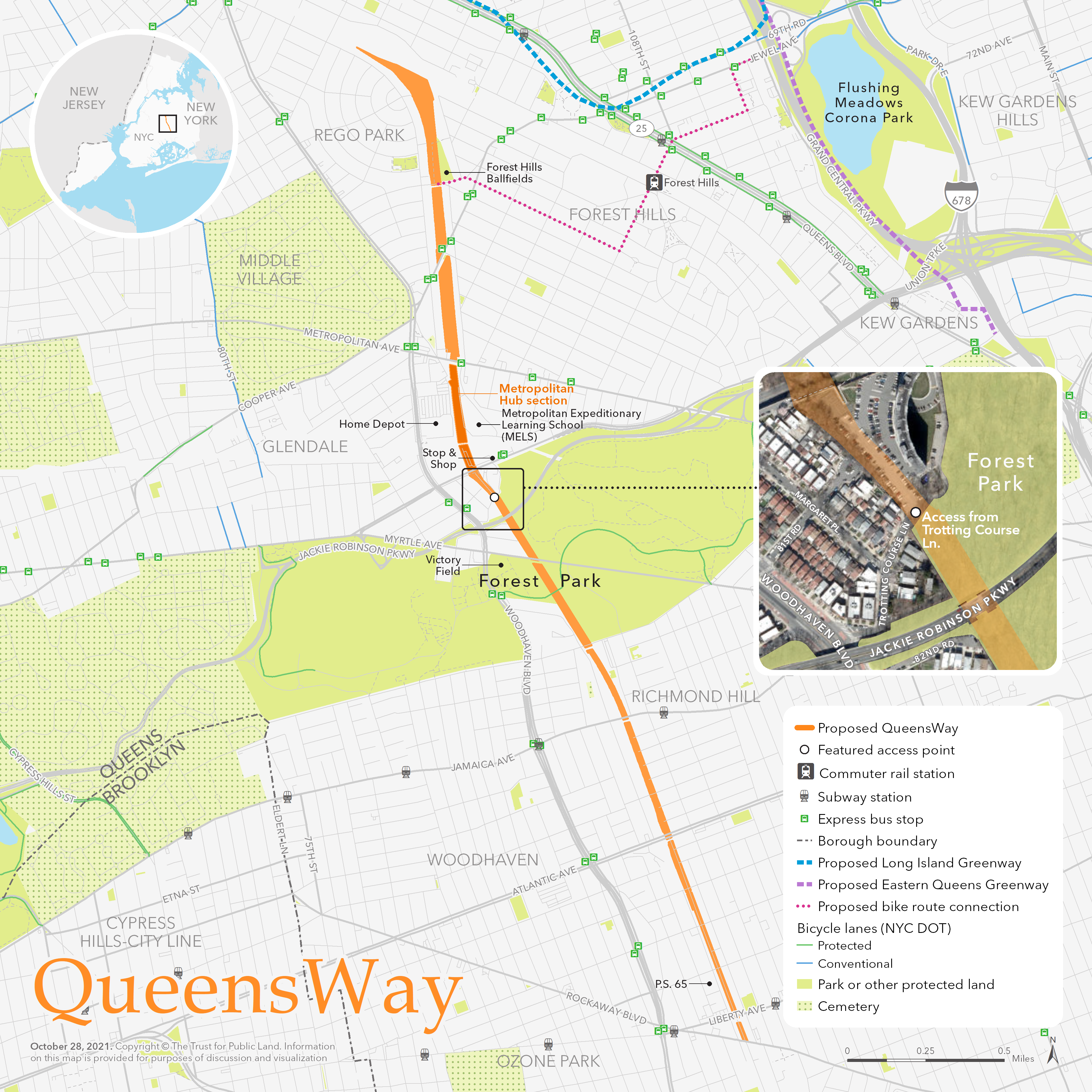
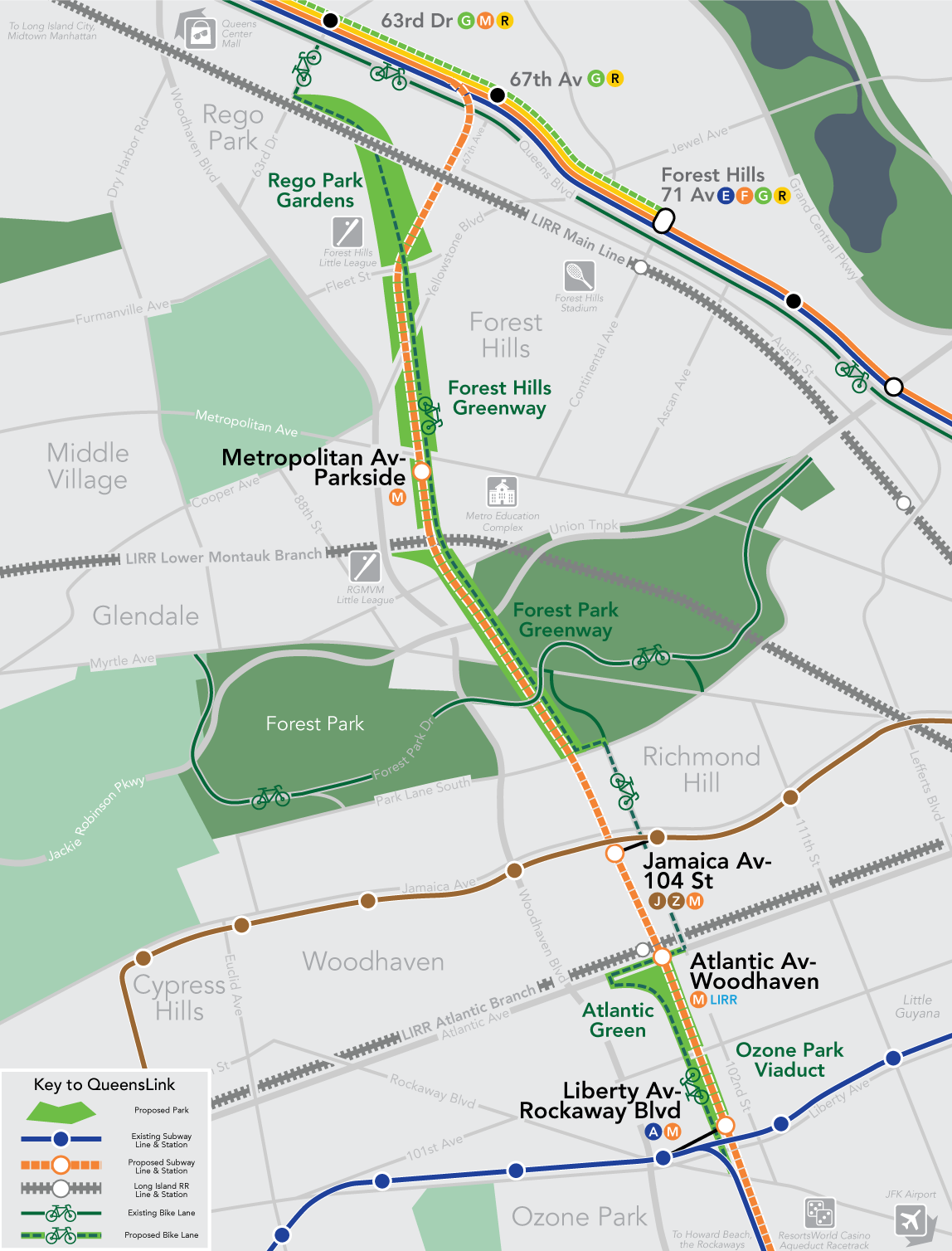
Inspecting a satellite map of Queens, you may notice two slices of green cutting north to south: one in a graceful arc from Woodside down through Ridgewood and into Brooklyn, the other bending through Rego Park before shooting a straight path through Ozone Park on its 3.5 mile route to Jamaica Bay. The first of these arcs will be the home of the Interborough Express, a $5.5 billion light rail line backed by Governor Kathy Hochul and actively being developed by the MTA. The second is an abandoned section of the Long Island Rail Road Rockaway Beach Branch with its future at a crossroads.

For many years, there have been two competing visions for this corridor: 

  • The QueensWay envisions transforming the elevated rail bed and surrounding land into a 47 acre linear park. 
  • The QueensLink envisions 33 acres of new parkland complementing an M line Subway extension from Rego Park to the Rockaways.

QueensWay and QueensLink proposals

The QueensWay vision is currently moving toward realization. The FY2023 NYC budget allocated $35 million for design and construction of a 5 acre park on the Metropolitan Hub section, a 0.7 mile stretch between Metropolitan Avenue and Union Turnpike. This March, Senator Schumer announced federal funding of $117 million for a second phase extending south from Union Turnpike through Forest Park.

Phase 1: Metropolitan Hub Section

Phase 2: Forest Park Pass Section

While strongly supportive of new parkland, QueenLink advocates are rightfully worried that the way these parks are designed will preclude future rail conversion. Queens Community Board meetings about the QueensWay have revolved around the possibility of rail reactivation, with representatives from the Queens Borough President, board members, and advocates all imploring consideration from the NYC Parks and NY EDC representatives. While there are some residents opposed to parks entirely, including one who relayed a colorful but dubious tale of finding sacrificial altars strewn with headless chickens along the trails deep in Forest Park, the primary conflict is between rails and parks versus parks without the possibility of rail. 

How did we get here?

The Friends of the QueensWay community group formed in Rego Park in 2011 with the goal of establishing an elevated park, and partnered with The Trust for Public Land to produce the QueensWay Plan in 2014. This plan was funded by NY State Parks and the Governor’s Regional Economic Development Council grants. Travis Terry, the current Friends of the Queensway President, played a key advocacy role through his political consultancy, Capalino. Further funding for designing the Metropolitan Hub section was secured in 2016 with the help of State Assemblyman Andrew Hevesi, City Councilwoman Karen Koslowitz, and several private foundations. Dormant for several years, the proposal gained new life in Mayor Eric Adams administration, who included initial phase funding in his first NYC budget. While not a visible campaign issue, Adams’ administration moved quickly to fund phase 1 development after Capalino assisted with then-candidate Adams’ mayoral campaign and transition, which has motivated allegations of backroom deals between Terry and Adams, who Terry praised at a QueensWay community board meeting in November 2023.

Starting on the other end of the LIRR Rockaway Beach Branch, support has been building for rail reactivation. Queens Community Board 14 in Far Rockaway passed a 2012 resolution in support, the MTA included reactivation of this section of the Rockaway Line as a possibility in their 2013 20 year needs assessment, Assemblyman Goldfeder funded a preliminary use study of rail reactivation by Queens College in 2013, and funding for an MTA feasibility study was included in the 2016 state budget. 

Unfortunately, the MTA study reported a shockingly high price tag: $8.1 billion dollars for 3.5 miles of rail. Community groups, including the Queens Public Transit Committee (QPTC), whose president Phil McManus warned, “we are going to have to monitor this study and make sure that it is done correctly,” suspecting the MTA was artificially inflating the estimate. An independent review commissioned by QueensRail, an advocacy group founded by Rick Horan, found that the MTA used non-standard estimation techniques and produced an alternative estimate between $3.4 and $3.7 billion. While the MTA partially revised the cost down in their 2023 20 year needs assessment they also reduced ridership estimates. Amid ongoing concern about the MTA’s estimates, Mitchell Moss, NYU Professor of Urban Planning, noted that, “The reality is that the MTA can only focus on so many projects, and the Second Avenue Subway and Interborough Express have their and the Governor’s attention.”

Regardless of the MTA’s current priorities, the community and political support around rail reactivation has only grown during this time. Initial advocacy for rail reactivation instead of parks pivoted to a “Rails and Trails” vision by QueensLink cofounders Rick Horan and Andrew Lynch. This vision has won the support of NY State Senator Jessica Ramos, NY State Assemblymember Jessica Gonzalez Rohas, City Councilperson and former NYC Parks Commissioner Shekar Krishnan, NYC Public Advocate Jumanne Williams, Queens Borough President Donovan Richards, Transportation Committee Chair Selvena Brooks-Pow­ers, and various other elected officials and community groups many of whom rallied for QueensLink at city hall in September 2023. Recent advocacy for inclusion in this year’s NY State budget generated more than 13 thousand emails and phone calls, and while funding was not included in the final bill, QueensLink organizers have vowed to continue their advocacy.

A Better Way Forward

While often framed in an adversarial manner, the QueensWay and QueensLink visions have many goals and components in common, including expanded park access, a bike lane network supporting cross-borough connectivity, safe pedestrian corridors, and improved quality of life for Queens residents. Without the active support of the MTA or state government, the window of opportunity for taking a transit-first development approach has also effectively closed, leaving a park-first approach as the reality. The first two phases of park development at the Metropolitan Hub and Forest Park Passage sections are funded and progressing through design and community feedback phases. Construction is expected to start within a year. 

A park-first approach doesn’t need to preclude eventual transit expansion, however. Better connectivity and transportation will only grow over time, as both Adams and Hochul prioritize efforts that will increase housing density and job centers in Queens. The Rockaway Beach Branch is also the only remaining right of way through the developed part of New York City, and as such represents the last hope of significantly expanding transit access without extensive tunneling. Building the QueensWay parks in such a way as to preclude rail reactivation in the future would therefore be a historically short sighted decision akin to Robert Moses building the Verrazano Bridge and Long Island Expressway without affordance for future mass transit development, which has doomed Staten Island and Long Island residents to traffic snarled commutes and artificially limited the whole region’s growth.

Putting QueensWay on the right track therefore involves building parks, yes, but in the right way: incorporating the possibility of rail reactivation as a guiding principle and nonnegotiable design goal. I implore Mayor Adams, Governor Hochul, and the rest of our elected officials to think of their legacy and instruct NYC Parks and EDC to make this contribution to future generations of New Yorkers.

You can reach the author of this piece, Jeremy Espenshade, at je2478@nyu.edu

You can reach the editor of this piece, Calley Wang, at: csw9856@nyu.edu

Navigating Colonial Challenges: The State of Public Transit in San Juan

 The promises and peril for transit expansion in Puerto Rico

Photo by: Gian Cordero

Last month in San Juan, after a week of free service, the Director of the Integrated Transit Authority of Puerto Rico (ATI) announced that the system saw a 26% increase in patronage, demonstrating that when the public perceives a public transit system as more convenient than personal vehicles for reaching destinations, they are inclined to use it. This phenomenon mirrors the heightened ridership experienced during events such as the Calle San Sebastian Festivities and activities hosted at the Choli (Puerto Rico’s primary arena), which generate significant and unusual patronage for the Tren Urbano (San Juan’s metro). However, despite these encouraging signs, the reality remains that our mass transit system presents numerous challenges for users including limited destinations, weekend service gaps, insufficient frequencies on most bus routes, and a lack of transit-oriented developments around stations. While efforts are underway to address some of these issues, some are being overlooked entirely, and others demand further analysis and innovative solutions.

 The Tren Urbano is the second newest metro system in the United States (only behind the Skyline in Honolulu), and runs through the municipalities of San Juan, Guaynabo and Bayamón in the metropolitan area of the capital city. The system is incomplete, with only one of the originally planned four phases finalized.  Proposed routes to key locations such as the International Airport, Old San Juan, and the densely populated areas of Santurce remain unbuilt. This shortfall can largely be attributed to two primary factors. Firstly, in 2006, shortly after the metro’s inauguration in 2004, Puerto Rico grappled with a fiscal crisis that precipitated a government shutdown. Secondly, the projected cost of the Tren Urbano surged by almost 150%, escalating from $800 million to $2.3 billion. Plans to build out the full system were officially scrapped in 2012 and no extensions have been built since the opening of the first line.

Delays and cost increases for large infrastructure projects are not unique to Puerto Rico. In fact, it could be argued that this is a problem that the colony inherited from the United States, where cost increases and delays are the order of the day for major infrastructure projects ranging from road construction to modernization of mass transit systems. A prime example is New York City’s Second Avenue Subway expansion project. Initially proposed in the 1920s, the project suffered numerous delays and cost increases over the years. Its first phase, which opened in 2017, cost approximately $4.5 billion, far beyond initial estimates. Cost increases and delays are often the result of a combination of complex factors. First, the very nature of large-scale infrastructure projects carries a variety of inherent risks, from land acquisition and expropriation to contract management and the coordination of multiple stakeholders and different levels of government. In addition, changes in political priorities and funding allocations can affect the continuity of funding needed to complete projects on schedule. Also, the need to comply with regulatory and environmental standards set by the federal government, as well as the influx of lawsuits (or threats of) from disgruntled citizens, can lengthen lead times and increase operating costs. While environmental regulations and safety standards are essential, they underscore the challenges Puerto Rico faces within the colonial framework, navigating federal laws and policies that hinder local development and bureaucratize infrastructure projects.

A good way to look at this would be to contrast Puerto Rico with the neighboring Dominican Republic, with which it probably shares more similarities both physically and socially than with any U.S. state. Currently, the city of Santo Domingo is seeing one of the largest mass transit transformations in the hemisphere. In September 2023, Dominican authorities announced a mega-project to expand the capital city’s integrated transportation system. This project would add two train lines, a light rail line, and a cable car line to the existing network of two metro and two cable car lines (the most modern urban cable cars in the world). This expansion is projected to cost $3.6 billion, a sum unimaginable for a project of similar scale within any U.S. territory, including Puerto Rico. For Yindhira Taveras Canela, engineer and professor at the Universidad Autónoma de Santo Domingo, “In the United States it is a little different because there are more funds, Puerto Rico could really have a much more efficient system because it is not a question of funds as in the Dominican Republic.” She also highlights that “Puerto Rico has another advantage, and that is that they have many engineers studying at the University of Puerto Rico who are being underutilized or are leaving to the United States for better salaries. Puerto Rico has everything to get ahead in terms of transit projects and could even provide an incentive for more young people to study and stay working on their developments.”

Unlike Santo Domingo’s growing rail network, San Juan’s rapid transit system has stagnated due to escalating costs and Puerto Rico’s fiscal crisis. (Tren Urbano map from ATI)

Beyond the financial and logistical challenges, Puerto Rico grapples with ingrained planning and land use practices mirroring those historically employed in the United States, from the overuse of single-family residential zoning, to urban street designs centered around private vehicle reliance. This is related to the cultural aspect of how we prefer to inhabit cities. As in the United States, many people in Puerto Rico see the home with a two-car garage and a large backyard as synonymous with progress, ignoring the livability of public spaces in our cities. However, I think that idea is breaking down, especially among the younger generations. Gian Cordero, a high school student who has used his platforms to educate about and improve mass transit in Puerto Rico, says, “We young people want to explore our system, and we want to be part of it. The buses, and the Tren Urbano become part of our lives as we think about our future as citizens.”

Puerto Rico’s colonial status presents obstacles to the development of mass transit services on the island. However, cultural changes in terms of citizen behavior and attitudes towards transportation and the livability of public spaces present a unique opportunity to eliminate the inconveniences of the transportation system. Now is the time to learn from past mistakes, take advantage of present opportunities, and aspire to a future where dependence on the private automobile is not the norm in Puerto Rico. San Juan, like Santo Domingo, can set an example for the rest of the world.

 You can reach the author of this piece, Gabriel Negrón Torres, at: gan9751@nyu.edu

You can reach the editor of this piece, Calley Wang, at: csw9856@nyu.edu


Selling Transit Dreams

Why transit agencies and advocates should learn from car ads to make planning less contentious

The Bus. From GO. The GO Bus. - YouTube

Image credit: GO Transit

Adam Gopnik writes that transit advocacy in the US lacks the same “passionate constituency aroused by cars and by bicycles,” with most people willing to “settle for Chinatown buses and carpools and shuttle planes,” for example, despite wishing for high-speed rail. While anyone who has spent any time on Transit Twitter (including this author) would jump to counter that there are, in fact, people “passionate about public transportation,” Gopnik is right about the majority of Americans outside the urbanism and transportation advocacy bubble. For most people, transit just isn’t part of daily life.  Fewer than 4% of adults commute to work using public transit. A 2016 survey found that only 11% of US adults took public transportation for any reason on a daily or weekly basis. Meanwhile, 92% percent of US households own at least one vehicle, meaning the concerns of driving and being a driver are already familiar and relevant to them.

How does this lack of a transit constituency affect planning? When conducting public engagement for transit projects, planners often start at a disadvantage, facing apathy if not outright hostility. It’s difficult to implement a truly transformative transit project, especially if it involves compromises such as reduced parking, fewer bus stops, or a more efficient but unfamiliar new route in a bus network redesign. Some of the negative sentiment stems from historically poor service provided by neglected transit agencies or simply distrust of government. But another key reason that communities that would otherwise be neutral are often cynical about, critical of, or hostile toward specific transit projects—even if they are generally supportive of the idea of transit—is the media they consume.

National and local media tend to focus on issues affecting transit, such as tragic incidents of violence. While some outlets add caveats that transit is safe overall, the average reader glancing at headlines will still come away with the notion that transit is unsafe and unreliable. Each new incident brings with it the same hand wringing about public transportation as a mode of travel. Meanwhile, the tens of thousands of annual deaths in car crashes have yet to vault the questioning of driving and car reliance from the likes of Streetsblog into the mainstream. Nor do the safety and congestion issues caused by car travel shape people’s views of automakers in the way that issues affecting transit routinely make transit agencies punching bags for suburban drivers and transit enthusiasts alike. 

To put it simply, perceptions of transit could use a lot of help—and the numbers-focused, facts-based messaging commonly put out by transit agencies, while appealing to nerds like me, don’t always work with general audiences. Amtrak has lately put out some decent ads touting the relaxing vibes of rail travel. But these ads still play it pretty safe. I contend that there is a further level of fantasy that transit agencies and advocates can and should be willing to sell. And where better to learn how to sell fantasies about a (branded) mode of transportation than car advertising?

Spend any time watching YouTube or TV and you will be bombarded with car advertisements featuring scenarios including but not limited to: speeding through apocalyptically empty city streets, chasing a dog named Bear through a forest, backing into a cliff-edge parking spot, and “unlocking the energy” by learning lessons à la a martial arts protagonist. There’s even an entire sub-genre of feel-good ads, of which Kia’s “beachcomber” ad is one of the most infamous examples. While most buyers will actually be spending their time stuck in traffic or searching for parking, these ads don’t care. They sell the idea of the car as a symbol of freedom, mobility, and individualism.

Transit agencies, advocates, and marketers can tap into the same emotional side of the brain, and they have many examples of what is unique and amazing about transit to choose from. Is it the joy of a child on their first subway ride? That feeling of running to meet a loved one after getting off a long-distance train and walking straight into the downtown core for a stroll? The “could it be?” feeling of a chance encounter with a long-lost friend on the bus? The togetherness of sharing a train with fellow Swifties to the concert? Good transit and walkability can enable these powerful feelings and positive experiences, which makes it even more important to highlight them. 

Put another way, through storytelling, marketing can convey how effective transit can change the way one views and experiences a place. Fast and frequent transit can “compress” time and space, making new kinds of journeys possible and enabling more spontaneous experiences, for example. These are the qualities that can be unconvincing on paper, especially when described to people who have not experienced living amid a good transit network.

The goal should not be to influence individual trips, which in many parts of the country are objectively more difficult to make via transit, but to alter the perceptions and sentiments about transit among the masses in the long run. This is no different than how the most effective car advertisements are not about selling a particular make and model but about getting viewers to equate “freedom” with one brand or “luxury” with another, so that the 19-year old who sees an ad during the NBA Finals might just buy an SUV from that manufacturer when they land their first big paycheck at age 27. With effective marketing of transit, maybe that guy stays car-free and shows up to his community board meetings to support transit improvements instead.

To be clear, many transit agencies are already getting creative with their messaging, whether through anime mascots or Taylor Swift mashups. But there is still a lot of room to push the envelope, and third-party interests (the passionate transit advocates) could help agencies get past the financial and creative barriers they may face when it comes to marketing to wider audiences and people who do not interact with transit regularly. Success in terms of increased ridership or revenue will take time, and the absence of immediate results should not be held against out-of-the-box types of marketing. Decades of transit being perceived as the mode of last resort will not be easy to overcome, especially given how long it takes to build the improved transportation infrastructure designed to increase ridership and satisfaction. Effective marketing could start to reshape what transit symbolizes for Americans into something positive and desirable in a much shorter time span. Improved public perception could then feed into a virtuous cycle. Transit planners would enjoy more productive feedback and a higher degree of consensus. The communities they engage with would receive better projects and outcomes, further improving their views of transit.

NYC Rent Stabilization is Safe, For Now

U.S Supreme Court declines to hear rent stabilization cases

Source: Politico

On February 20, the Supreme Court denied requests to hear the appeals of two cases relating to New York City’s Rent Stabilization Law (RSL). The two cases came from trade organizations and the owners of apartment buildings in New York City, who believe the RSL is an unconstitutional taking of their land. The request, known as a writ of certiorari, was initiated after the U.S. Court of Appeals for the Second Circuit rejected arguments made against the RSL. The landlords in Community Housing Improvement Program v. New York City argue that the RSL is facially unconstitutional (that the law is unconstitutional in all possible applications).The landlords in 74 Pinehurst LLC v. New York allege the same but further argue that the RSL is unconstitutional as it applies to them (meaning that even if there are valid applications of the law, using it against these landlords is not valid). The Court of Appeals rejected these arguments in February 2023 and the landlords appealed to the Supreme Court in May 2023. 

These cases were brought as a result of 2019 amendments made by the New York State Legislature to enhance protections for renters. These updates to the law include limiting property owners’ ability to raise rents to cover individual apartment improvements, capital improvements, or to make up for years where they raised rents below the legally allowable maximum. The amendments also removed pathways that landlords could use to “deregulate” rent-stabilized units and begin charging market rate rents, such as when rents reached a certain threshold or when the unit is occupied by someone making over $250,000 a year. As a result, the property values of rent-stabilized buildings fell and building owners decreased their investments and spending on upgrades in rent-stabilized buildings. Additionally, of the nearly one million rent-stabilized units in New York City, nearly 10 percent are vacant and about half of those are deemed “unavailable.” Landlords and trade organizations then brought the lawsuits involved in these cases, arguing that these changes constitute a taking of their property rights. 

In its decisions released last year, the Second Circuit rejected these arguments following similar dismissals by the respective district courts. The Appeals Court reasoned that the RSL as amended does not constitute a taking because “States ‘have broad power to regulate housing conditions in general and the landlord-tenant relationship in particular.’” It went on to say that landlords are not without other ways of controlling their property, such as other pathways to evict tenants, and, even if they cannot decide who occupies the space due to successorship provisions, that does not cause a physical taking of property. The landlords then appealed to the United States Supreme Court.

The Supreme Court ultimately decided not to hear the cases. The Court does not usually explain why it refuses to hear cases, as was the case here. However, Justice Clarence Thomas issued a statement respecting the denials. In his statement, Justice Thomas explains that the landlords’ claims are based on generalized allegations that would complicate the review of their cases. He goes on to say that their claims do not easily enable the court to clearly understand how New York City regulations work together to bar landlords from evicting tenants as the landlords claim. However, Justice Thomas ends his statement by saying “in an appropriate future case, we should grant certiorari to address this important question.” Thus, Justice Thomas is leaving the door open on this issue and inviting other landlords without the issues he identified to try again, hinting that they may have a better chance. 

While it is unclear if any other Justices on the Court agree with Thomas, his posturing is concerning for advocates of rent stabilization given how the 6 to 3 conservative court has been using its power in recent years. From overturning decades-long precedent to allow states to ban abortions, to expanding the meaning of the Second Amendment to limit how states can respond to mass shootings, and to allowing businesses to turn away gay couples seeking services in public accommodations, this court is changing the social and political fabric of the United States. Time will tell if this court will receive a rent stabilization case again soon and what it will say, but whenever that is and whatever it says will impact millions of people who rely on the RSL to live affordably in New York City.

You can reach the author of this piece, Jake Mericle, at: jm9776@nyu.edu 

You can reach the editor of this piece, Calley Wang, at: csw9856@nyu.edu