• Skip to main content
  • Skip to primary sidebar
  • Skip to footer

Borderlands

guantanamo bay

Guantanamo Record: The Cuban (CAA) Act 1966 and Venezuelan TPS 2025

February 5, 2025 by James L'Angelle Leave a Comment


Castro in 1994: U.S. Needs to Change 'Old, Obsolete Policy' Toward Cuba

Introduction

     The decision to summarily yank protected immigration status for nearly half a million refugees from South America has been criticized by many as a “sudden shift” in policy, “a reversal.” It’s neither. President Clinton set the precedent back in 1994 when Communist dictator Fidel Castro sent up a green flare allowing anyone who wanted to leave Cuba was free to go. The trail to the current decision began with that embarrassing moment in American immigration policy.

     The paper begins with examination of the Cuban Adjustment Act (CAA) of 1966, which allowed refugees from the island unfettered access to American soil, under the facade of doing the right thing, even if doing the right thing had more to do with toppling Castro than it did with an open border for refugees. 

(Image Credit: Castro in 1994: U.S. Needs to Change ‘Old, Obsolete Policy’ Toward Cuba)

Methodology

     Research Capsules contain a.) social media an “X” post by @jameslangelle; b.) an artificial intelligence query enclosed in parentheses (Begin Perplexity-AI) and (End Perplexity-AI); c.) Notes to analyze, clarify, acknowledge-refute the claims made in the AI query. The social media posts may or may not appear in each capsule. The AI queries have a link included and numbers in the text link to the references used by AI. 

     Following the Capsules is the heading Congressional Record, where archived floor discussions and debates are extracted from the record regarding the progress of legislation, or events critical to action taken by congress. Brief bios of those directly involved in those floor actions are included through AI queries.

     Lastly, Newspaper Archives are searched for articles, opinion pieces and reports on the progress of the subject. In this case, it will be directed more at a.) the CAA’66 and what happened in 1994 when Castro sent up the green flare.

Capsules

Cuba 1994

(Begin Perplexity-AI)

the cuban adjustment act of 1966

The Cuban Adjustment Act (CAA) is a United States federal law enacted on November 2, 1966, by President Lyndon B. Johnson12. This legislation provides a unique path for Cuban natives or citizens to obtain lawful permanent residency in the United States25. Key features of the Cuban Adjustment Act include:

  1. Eligibility: The act applies to Cuban natives or citizens who have been inspected, admitted, or paroled into the United States after January 1, 19591.
  2. Residency requirement: Applicants must have been physically present in the U.S. for at least one year12.
  3. Expedited process: The CAA allows Cubans to bypass standard immigration rules and obtain permanent residency more quickly and easily than other immigrants2.
  4. Family inclusion: The act also applies to non-Cuban spouses and children of eligible Cuban applicants2.
  5. Exemptions: Cubans are exempt from immigration quotas and certain requirements imposed on other immigrants, such as showing family-based or employment-based reasons for residency1.

Historical context and modifications

The CAA was enacted during a period of significant Cuban migration to the United States following the Cuban Revolution. Between 1960 and 1970, the Cuban population in the U.S. grew from 79,000 to 439,0004.Over the years, the act has undergone several modifications:

  1. Refugee Act of 1980: Reduced the required physical presence in the U.S. from two years to one year1.
  2. Wet Foot/Dry Foot policy (1995-2017): This policy allowed Cubans who reached U.S. soil to request parole and eventually adjust their status under the CAA34.
  3. 2017 changes: The Obama administration ended the Wet Foot/Dry Foot policy and modified the CAA to prohibit its exemption for Cuban nationals entering the U.S. without visas4.

Despite these changes, the Cuban Adjustment Act remains in effect, continuing to provide a unique pathway for Cuban natives and citizens to obtain permanent residency in the United States15

https://www.perplexity.ai/search/the-cuban-adjustment-act-of-19-Ko4ynY7jREKNUc1jQ8pVQg

president clinton halts cuban adjustment act during operation able vigil 1994

President Clinton did not halt the Cuban Adjustment Act during Operation Able Vigil in 1994. However, he did significantly change the U.S. policy towards Cuban immigrants810. On August 19, 1994, President Clinton announced that Cuban refugees would no longer be allowed to enter the United States automatically8. This marked a major shift in the decades-long preferential treatment of Cuban immigrants. The key changes implemented were:

  1. Cubans intercepted at sea would be taken to the U.S. Naval Base at Guantanamo Bay, Cuba, rather than being allowed into the United States48.
  2. Cubans who managed to reach U.S. soil would be detained while their cases were reviewed for eligibility to remain in the country8.
  3. The Coast Guard, backed by the Navy, was ordered to intercept refugees at sea as part of Operation Able Vigil68.

These policy changes were aimed at preventing a repeat of the 1980 Mariel boatlift, during which 125,000 Cubans entered the United States8. President Clinton emphasized that this was a permanent reversal of the previous 30-year policy8. It’s important to note that while these changes significantly altered the implementation of the Cuban Adjustment Act, they did not halt or repeal the Act itself. The Cuban Adjustment Act remained in effect, but with more restrictions on how it was applied5

https://www.perplexity.ai/search/president-clinton-halts-cuban-LqMEAOhdRC6Is9U7fkVLiw

did clinton issue an executive order to halt the caa and send cuban refugees to guantanamo

Clinton did not issue an executive order to halt the Cuban Adjustment Act (CAA) or send Cuban refugees to Guantanamo. However, he did make significant policy changes regarding Cuban refugees in 1994 and 1995:

  1. On August 19, 1994, Clinton announced a new policy to stop the influx of Cuban refugees25. This policy change:
    • Ended the automatic granting of asylum to Cuban refugees
    • Ordered the Coast Guard to intercept Cuban refugees at sea
    • Directed that intercepted refugees be taken to the U.S. Naval base at Guantanamo Bay, Cuba
  2. In 1995, Clinton implemented the “wet foot, dry foot” policy17. This policy:
    • Allowed Cubans who reached U.S. soil (“dry foot”) to stay and apply for permanent residency under the CAA
    • Required those intercepted at sea (“wet foot”) to be returned to Cuba or sent to another location

These changes were significant policy shifts but did not halt the CAA itself19. The CAA remained in effect, allowing Cubans who reached U.S. soil to apply for permanent residency after one year7. The policy changes were implemented through administrative actions rather than an executive order25.

https://www.perplexity.ai/search/did-clinton-issue-an-executive-hXVeIg7qQFWzkRdyeVAMDQ

(End Perplexity-AI)

     Notes: The difference here being the sudden uncontrolled surge in boat people following the announcement by Castro; it overwhelmed the administration’s capacity to process the flotilla, and the Coast Guard was forced to interdict. It was suggested in Congress immediately following the surprise invasion that they be sent to Guantanamo in order to free up the cutters to intercept more of the boat people, a danger to themselves and everyone else. As will be seen in the case of the Venezuela TPS revocation, “national interests” were cited, but those are vague at best and appear to be more politically motivated.

Congressional Record
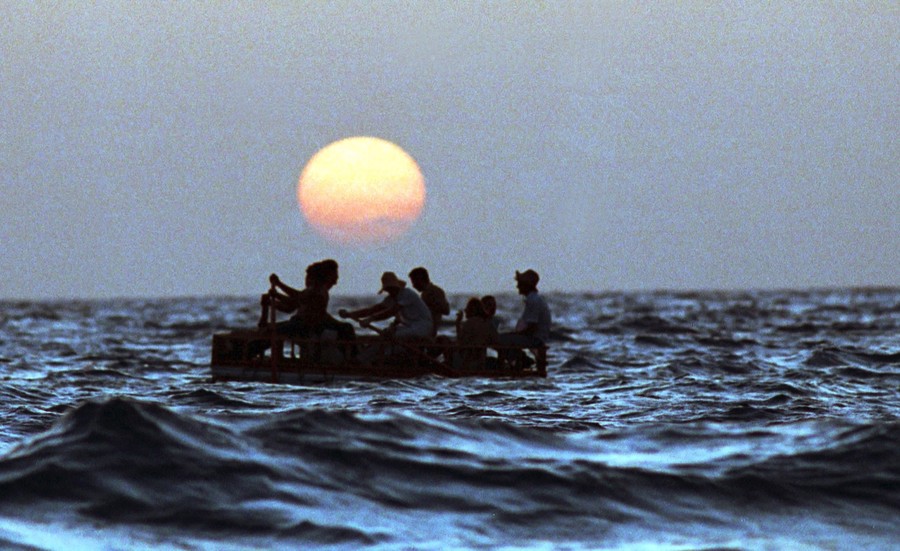
     Notes: Reaction to the announcement by the Communist dictator Castro was met with surprise and outrage in Congress, much of it directed at President Clinton for inability to take action on immigration. Most of that was already boiling over from the Haiti snafu, and the fact HIV-infected Haitian refugees were being allowed into the United States for treatment.

(Image Credit: 20 Years After the 1994 Cuban Raft Exodus – The Atlantic)

(Begin Congressional Record)

CUBAN ADJUSTMENT ACT NEEDS SECOND LOOK

(Mr. MAZZOLI asked and was given permission to address the House for 1 minute and to revise and extend his re- marks.) 

     Mr. MAZZOLI. Mr. Speaker, yesterday at this time, from this well, I indicated that the United States was facing an immigration emergency, and I reached that conclusion from reading the papers as well as from having a briefing by administration officials…

     Attorney General Reno says, we will detain all incoming Cubans. Where? Where will we detain all those incoming Cubans? Florida? Fort Chaffe, AR, Guantanamo? Come to think of it, Guantanamo may make some sense. It is already in Cuba. Possibly we could make room there, if we ask the 15,000 Haitian refugees already there in tent city if they mind moving to Mariel, Cuba.

     Rep. Romano L. Mazzoli (D-KY), GPO-CRECB-1994-pt17-1-2.pdf, 19 August 1994,  page 23291.

CUBA

     The SPEAKER pro tempore. Under a previous order of the House, the gentleman from Florida [Mr. Goss] is recognized for 5 minutes. 

     Mr. GOSS. Mr. Speaker, I just wanted to take a moment to say that I think many Americans have just observed the President of the United States doing a press conference on the situation in Cuba, among other things.

     The President has indicated that we are basically adopting a different procedure toward people who are trying to flee from the oppression of Castro’s Cuba. Apparently we are going to divert people who are leaving Cuba to get away from that oppression to other safe haven areas. 

     Unfortunately, we have not had any specifics of that. We need to know what those safe haven areas are going to be.

     The President specifically mentioned, Mr. Speaker, that they were going to use Guantanamo Bay, which I suppose makes some sense because that is in Cuba. The problem with using Guantanamo Bay, of course, is that it may violate some of the contractual arrangements we have on that base.     

     The other serious problem is that there are already about 15,000 Haitian refugees as a result of our problem policy with regard to Haiti. So it seems to me that there is going to be a need to find some additional safe havens, because I do not think there is any likelihood that the cruel oppressive violation of human rights policies of Fidel Castro are going to change any time soon.

     Inevitably, there are going to be people who are trying to get away from the Castro regime especially at a time when the country’s economy is crumbling very rapidly because they have lost some of the special arrangements they had with the former Soviet client states.

     We may very well be looking at the prospect of people in the Florida Straits trying to get away from Fidel Castro and people in the Windward Passage trying to get away from the misery we are producing in Haiti, and our United States Coast Guard and Navy and a tent city on Guantanamo, all at a time when the third hurricane of the season hits next week. Let us pray that does not happen, Mr. Speaker, and let us pray that we get some foreign policy out of the State Department before then. I think it is important.

Rep. Porter J. Goss (R-FL), GPO-CRECB-1994-pt17-1-2.pdf, page 23319-23320.

(End Congressional Record)

     Notes: Neither impressed nor pleased with the President’s performance regarding Cuba was illustrated by Porter Goss with his comparison to the existing crisis in Haiti and the refugees already at tent city. He was keen to note also an impending hurricane, adding to the urgency that seemed to be brushed off by the White House. He noted in the speech that President Clinton would house the refugees at, “Guantanamo and other places we are working on.” Clinton had no plan.

(Begin Perplexity-AI)

https://www.govtrack.us/congress/members/porter_goss/400156

rep goss house 1994

Porter Johnston Goss, a Republican from Florida, was a member of the U.S. House of Representatives during the 1994 elections12. He represented Florida’s 14th congressional district, which included Fort Myers, Naples, and part of Port Charlotte2. Goss was re-elected in the 1994 midterm elections, which saw a significant Republican victory known as the “Republican Revolution”1.The 1994 elections resulted in a 54-seat swing from the Democratic Party to the Republican Party, giving Republicans control of the House for the first time since 19521. This marked a major political realignment, especially in the South, where Republicans gained 19 seats and outnumbered Democrats for the first time since Reconstruction1.Goss continued to serve in the House until September 23, 2004, when he resigned to become the Director of the Central Intelligence Agency34. During his tenure in Congress, Goss held several important positions, including:

  1. Chairman of the House Permanent Select Committee on Intelligence (1997-2004)
  2. Co-sponsor of the USA PATRIOT Act
  3. Co-chair of the Joint 9/11 Intelligence Inquiry

Goss was known for his strong support of the CIA and consistently advocated for increased budget allocations for the agency2

https://www.perplexity.ai/search/rep-goss-house-1994-9Z2wApP7RumdJGwOddd5uQ

(Image credit: Rep. Porter Goss [R-FL14, 1993-2004], former Representative for Florida’s 14th Congressional District – GovTrack.us)

(End Perplexity-AI)

     Notes: Goss had a direct stake in the fate of the refugees, having already been in the driver’s seat as a representative in Congress from Florida. He had witnessed the disregard by the White House, transferring HIV-infected Haitians from the base to his state for treatment. Certainly, it was the humane thing to do, but in the eyes of politics, not the most practical.

(Begin Congressional Record)

A Makeshift Raft Speaks to the Risks Cubans Took to Escape Their Homeland | Smithsonian

PRESIDENT SHOULD NOT UNDO THE CUBAN ADJUSTMENT ACT 

     The SPEAKER pro tempore. Under the Speaker’s announced policy of February 11, 1994, and June 10, 1994, the gentleman from New Jersey [Mr. MENENDEZ] is recognized for 60 minutes as the designee of the majority leader. 


(Image credit: A Makeshift Raft Speaks to the Risks Cubans Took to Escape Their Homeland | Smithsonian)

     Mr. MENENDEZ. Mr. Speaker, I want my comments today directly to go to our President with reference to the situation in Cuba. I am joined this evening by my distinguished colleague from Florida [Ms. ROS-LEHTINEN], whom I will yield to in a few moments. I think this is a very important time. 

     I want to yield to my distinguished colleague, the gentlewoman from Florida [Ms. Ros-LEHTINEN]. Ms. ROS-LEHTINEN. I thank the gentleman for yielding to me. 

     The decision by the Clinton administration of intercepting in the high seas and then detaining at the Guantanamo Naval Base Cuban refugees who flee the Castro regime is indeed extremely disappointing. These Cuban refugees who risk their lives in the high seas in search of freedom should be processed as indicated by the Cuban Adjustment Act and be granted political asylum. The wave of Cuban refugees will not stop, as Mr. MENENDEZ pointed out, until the root cause of the problem, and that is the Castro dictatorship, is eliminated from Cuba.

Rep. R. Menendez, (D-NJ), GPO-CRECB-1994-pt17-1-2.pdf, 19 August 1994, pages 23336- 23340

(End Congressional Record)

Venezuela 2025

background on venezuela tps

Temporary Protected Status (TPS) for Venezuela was first designated on March 9, 2021, by Secretary of Homeland Security Alejandro N. Mayorkas due to extraordinary and temporary conditions in the country36. The initial designation was based on Venezuela’s complex humanitarian crisis, marked by widespread hunger, malnutrition, growing influence of non-state armed groups, repression, and crumbling infrastructure6.

Key Developments

  1. 2021 Designation: The original TPS designation for Venezuela allowed eligible Venezuelan nationals to apply for temporary protection and work authorization in the United States4.
  2. 2023 Extension and Redesignation: On September 20, 2023, Secretary Mayorkas announced an 18-month extension and redesignation of TPS for Venezuela3. This decision was made due to increased instability and lack of safety in Venezuela3.
  3. 2025 Extension: On January 10, 2025, the Department of Homeland Security announced another 18-month extension of TPS for Venezuela, running from April 3, 2025, to October 2, 20262.

Eligibility and Benefits

  • Continuous Residence: Applicants must have continuously resided in the United States since July 31, 2023, for the latest redesignation25.
  • Protection from Removal: TPS provides temporary protection from deportation for eligible individuals3.
  • Work Authorization: TPS beneficiaries are eligible for employment authorization documents (EADs)3.

Current Status

As of February 2025, there are approximately 242,700 TPS beneficiaries under Venezuela’s existing designation, with an additional 472,000 Venezuelan nationals potentially eligible under the redesignation3. The TPS designation for Venezuela is set to expire on October 2, 2026, unless further extended4.

https://www.perplexity.ai/search/background-on-venezuela-tps-yxOOXJKUSeWkZkAmX6Lt9w

can president remove venezuela temporary status

Yes, the President can remove Temporary Protected Status (TPS) for Venezuelans in the United States123. On February 3, 2025, the Trump administration, through Homeland Security Secretary Kristi Noem, terminated the 2023 TPS designation for Venezuela56. This decision affects approximately 348,000 Venezuelans who were granted TPS in 20233. The termination will take effect 60 days after the publication of the notice in the Federal Register, which is expected to be around the first week of April 202536.

Key points:

  1. The President, through the Department of Homeland Security, has the authority to designate or terminate TPS for specific countries.
  2. The termination affects Venezuelans who received TPS under the 2023 designation14.
  3. Those affected will lose their legal status and work permits, potentially facing deportation23.
  4. An additional 250,000 Venezuelans with TPS expiring in September 2025 may also be at risk of losing their status in the future1.
  5. The decision has been met with criticism from Venezuelan-American communities and some lawmakers7.

This action represents a significant shift in U.S. immigration policy towards Venezuelans and demonstrates the President’s authority to modify or end TPS designations123.

https://www.perplexity.ai/search/can-president-remove-venezuela-yuA1pi_TRCe3GSIekhOLMA

what reason did president give for revoking venezuela tps

President Trump’s administration revoked the Temporary Protected Status (TPS) for Venezuelans, citing several reasons:

  1. Improved conditions: The Department of Homeland Security stated that conditions in Venezuela had improved enough to warrant ending protective status5.
  2. Program misuse: Secretary Kristi Noem argued that the TPS designation had been used to allow people without an immigration pathway to settle in America5.
  3. Local difficulties: The administration cited “associated difficulties in local communities” due to the large numbers of Venezuelan immigrants5.
  4. Gang concerns: The decision mentioned members of the Venezuelan gang Tren de Aragua among those coming to the U.S., raising security concerns5.
  5. National interest: The administration concluded that Venezuela no longer qualifies for the 2023 TPS designation as it would contradict the national interest of the United States1.

These reasons align with President Trump’s broader initiative to restrict immigration and conduct mass deportations of immigrants lacking permanent legal status3.

https://www.perplexity.ai/search/what-reason-did-president-give-EBLMETUZQqGUEbXlo8T4Ww

how does venezuela tps conflict with u.s. national interests

Secretary of Homeland Security Kristi Noem determined that continuing the 2023 Temporary Protected Status (TPS) designation for Venezuela was contrary to the national interest of the United States1. This conclusion was based on several factors:

  1. Improved conditions: Secretary Noem cited improvements in Venezuela’s economy, public health, and public safety that now allow Venezuelan nationals to return to their home country safely1.
  2. Program misuse: Critics argue that the TPS program has been exploited to enable migrants to remain in the U.S. much longer than originally intended, evolving from a temporary solution into a more permanent situation3.
  3. Immigration control: The termination of TPS for Venezuela aligns with the Trump administration’s efforts to restrict immigration and implement large-scale deportation initiatives3.
  4. Shift in policy: This decision represents a significant change from the previous administration’s stance, which had extended protections for Venezuelans citing dire conditions in their home country3.
  5. National security concerns: The decision implies that the continued presence of a large number of Venezuelan TPS holders may pose potential security or economic challenges to the United States, though specific details were not provided in the search results.

It’s important to note that this decision has been controversial and may face legal challenges from immigrant rights advocates3.

https://www.perplexity.ai/search/how-does-venezuela-tps-conflic-CYmOSn4VSv2ScYLXTXR5kw
 
(End Perplexity-AI)

Newspaper Archives:

Fort Myers News-Press, 22 August 1994, page 1.

■ Rescuers in action
By MARC BEAUDIN and JIM GREENHILL News-Press staff writers

STRAITS OF FLORIDA, ABOARD COAST GUARD VESSEL 

     There’s a shortage of the supplies people need to make rafts to leave Cuba, so Abel Vidal and brothers Fiorentino and Jose Gonzales came up with a solution some U.S. Coast Guard officers said they hadn’t seen before: tree limbs tied together with strips of rubber.

     The three were found Sunday by the recreational fishing vessel Nena III about 21 miles southeast of Key West. The Nena III out of Brandon, stayed near the raft while a 41-foot Coast Guard vessel headed to the rescue.
When the Coast Guard arrived at 3:15 p.m. Sunday, the three men — then crying and hugging — had survived five days and six nights in the Straits, traveling 60 miles.

     There, they were transfered to a 1113-foot cutter where dozens of other refugees watched from a lent. That vessel, in turn, will likely meet a still larger ship that will take up to 200 rafters to the U.S. Naval Base at Guantanamo Bay on Cuba,

     The four crew men on the Coast Guard vessel that rescued the three men symbolized the efforts the Coast Guard is nutting, faced with a surge of refugees. (Fort Myers News-Press, 22 August 1994, Page 1)

Afterword

     In reflection, the so-called summary dismissal of the Venezuelan TPS, will not go into effect immediately, as did the Clinton halt on the CAA in 1994. The President’s executive order needs printed in the Register after which another 60 days will pass. Even so, the consequences from such a change on an uneven keel could easily create chaos in homeland security’s search for a navigable course across treacherous waters, infested with vengeful sharks in the political realm, on hurricane waves of social media.
Filed Under: anthropology, boat people, cuba, guantanamo bay, immigration Tagged With: anthropology, boat people, cuba, cuban adjustment act 1966, fidel castro, politics, president clinton, venezuelan tps 2023

Guantanamo Bay 1993: Haitian HIV Prison Camp

February 4, 2025 by James L'Angelle Leave a Comment

Haitians Introduction

     Whether the current displaced vulnerable civilians being sequestered at the US naval base on the southeastern shores of Cuba are being screened for infectious, debilitating diseases before being airlifted out to tent city has yet to be established, either by the government, or by the media. 

     This review, of an historical nature, traces the prevalence of the Haitian boat people population which was interdicted in the waters of the 600 mile stretch between the island and the Florida Coast, and the health status discovered inside the camp. 

     The regime at the White House under President Clinton, which had just won the election in 1992, although promises were made to treat the refugees from Haiti in a civilized manner with due process and asylum requests, reverted back to the former president’s method and little was done that changed the plight of those trapped in the Guantanamo Bay camps.

(Image: Guantánamo Public Memory Project – HIV-positive Haitians at Guantánamo Bay)

Methodology

     The research will follow similar format of recent articles published on Borderlands surrounding the new White House policy. Capsules will contain a.) a social media post with a link (“X” post by @jameslangelle) where applicable, b.) an artificial intelligence query enclosed in parentheses (Begin Perplexity-AI) followed by (End Perplexity-AI), and c.) Notes, to analyze, clarify and refute, if necessary, the AI findings. The AI query will have a link to the search along with in-text links as to where the machine accessed the information.

     New sections, Congressional Record and Newspaper Archives, have been added to give a more complete perspective of how the issue played out in the government and in public opinion.

Capsules

“X” Post by @jameslangelle

(no post available for this query)

(Begin Perplexity-AI)

guantanamo bay haitian refugees with aids brought to united states for treatment in 1993

In 1993, Haitian refugees with AIDS who were detained at Guantanamo Bay were brought to the United States for medical treatment. This occurred after a series of legal and humanitarian challenges to their detention:

  1. On March 26, 1993, U.S. District Judge Sterling Johnson Jr. ruled that the government had to either provide adequate medical treatment for the HIV-positive refugees at Guantanamo or send them where they could be treated8. He described the facility as an “HIV prison camp”5.
  2. Following this ruling, the Clinton Administration announced that 36 Haitian refugees with the AIDS virus would be brought to the United States2.
  3. On April 5, 1993, the first group of 20 Haitians, including 16 infected with HIV, were flown from Guantanamo to the United States2. Priority was given to those with low immune cell counts2.
  4. By June 1993, Judge Johnson ordered the release of all remaining HIV-positive Haitian refugees from Guantanamo within two weeks57.
  5. The camp housing these refugees, known as Camp Bulkeley, was finally closed on July 18, 19937.

This decision marked a significant shift in policy, as previously these refugees were denied entry to the U.S. solely based on their HIV status, despite being accepted as having legitimate claims for asylum14. The move came after concerns about inadequate medical care and poor living conditions at the Guantanamo facility145

https://www.perplexity.ai/search/guantanamo-bay-haitian-refugee-bZQ0541gQye6z.ICtFxIVw

(End Perplexity-AI)

Notes:  Following the ruling by the judge, Congress took up the debate when the AIDS infected Haitians were brought into the United States for treatment, with those concerns entered into the Congressional Record.

Congressional Record

HIV -INFECTED REFUGEES

     (Mr. SOLOMON asked and was given permission to address the House for 1 minute and to revise and extend his re- marks.)

     Mr. SOLOMON. Mr. Speaker, recently a Federal judge ruled to admit the HIV -infected refugees being held in Guantanamo Bay into the United States.

     Last week, the Washington Post reported that the White House will not appeal this ruling.

Solomon, 14 June 1993, 12567

     Mr. Speaker, has President Clinton already forgotten the NIH bill he signed that codified the ban against allowing people with deadly diseases into the United States? Doesn’t he realize the cost to taxpayers for each person admitted with the deadly HIV infection? And most importantly, doesn’t he realize that he is jeopardizing the health and well-being of American citizens?

     I haven’t forgotten that it costs over $100,000 to care for each HIV infected individual. And, I haven’t forgotten that HIV always leads to AIDS, which always leads to death.

     Mr. Speaker, this country needs the President to look out for her best interests, not his own political interests. It is time for the President to stop trying to be on all sides of an issue. He should instruct his Attorney General to appeal this case, and block these AIDS-infected immigrants from crossing our borders.

(Rep. Gerald B.H. Solomon, R-NY, 14 June 1993, 12567)

HIV-INFECTED HAITIAN ENTRY 

     The SPEAKER pro tempore. Under a previous order of the House, the gentleman from Florida [Mr. MICA] is recognized for 5 minutes. 

Rep. Micah, R-FL

     Mr. MICA. Madam Speaker, I rise today to inform the Congress and the American people of an impending disaster. Last Thursday I was joined by more than 40 Members of Congress who asked our President to uphold the law of this land. 

     Current U.S. immigration law bans HIV-infected persons from entering this country. We asked the President to uphold this ban. 

     I want to make clear at the outset that I am the grandson of immigrants, and am proud of this country’s legal immigrants. But my grandparents were required to meet certain health requirements. That was the law then, and that is the law now. 

     However, something alarming has happened this morning and will continue to happen until U.S. law is enforced: This morning the United States Government flew dozens of HIV-infected Haitians, who were held at Guantanamo Bay, Cuba, to Florida. Eight more flights are scheduled to take the remaining refugees to the United States. 

     This action threatens Florida with a financial disaster. This action threat- ens a medical disaster for this country. 

     I am especially outraged because Congress has spoken on this issue. The House and other body both voted overwhelmingly to codify the rule specifying that HIV infection is a public health concern that is a basis for excluding anyone from any country from entry into the United States. What is even more compelling is that President Clinton recently signed the bill that contained this ban. 

     How did we get to where we are today, flying these HIV-infected Haitians to our country? A Federal judge is deciding U.S. policy on an issue that has far-reaching public health and fiscal consequences for our Nation. How can one judge so easily reverse the will of the Congress? 

     I dispute the notion that a Federal judge should make this kind of policy. There were over 40 other Members of this House that joined me in pleading with the President to prevent this catastrophe from occurring. 

     Our voices have not been heard. Apparently, the President is still debating whether or not to appeal this decision. 

     As I said, many of the HIV-infected Haitians are already here. The rest will follow. Once here, they will receive medical benefits and a host of other refugee program services. 

     I know that Florida cannot afford to bear the financial burden of these HIV-infected refugees. Florida has already taken a large number of the Haitian immigrants. Specifically, between 82 and 93 percent of the 10,000 plus Guantanamo Haitians brought to the United States have remained or returned to Florida. This imposes huge costs on our State. We have also just survived Hurricane Andrew and are attempting to rebuild those communities in south Florida. We simply cannot afford these high risk immigrants.

      Madame Speaker, I urge my colleagues and fellow Americans to let President Clinton know that it is his chief responsibility to enforce the laws of our country. 

     He should appeal this decision immediately, and avert the potential financial and medical disaster for Florida and the Nation. (Rep. John L. Micah, R-FL, 14 June 1993, 12598)

GPO-CRECB-1993-pt9-6-2.pdf

Notes: The Republicans did not approve of the plan, including Micah, whose 7th district extended from Orlando to Jacksonville. By contrast, the Democrats had a different take on the ruling by the judge to allow HIV-infected Haitian refugees on to American soil for treatment.

     At the same time, we have had some other developments which have moved things a bit. The Federal judge, Judge Sterling Johnson, ruled that the Haitians at Guantanamo Bay who have HIV infections must be brought to the United States and given appropriate medical care, a humane act which I consider very important if this Nation is to maintain its image in the world as really being a nation that cares about people. The White House did not challenge or appeal that ruling. That is another step forward. (Rep. Major Owens, D-NY, 14 June 1993, 12610, link above)

Newspaper Archives

Haitians With AIDS Coming To America

WASHINGTON (AP) — The Clin-ton administration will comply with a court order and allow 36 Haitian refugees with full-blown AIDS to come to the United States for treatment. But the Justice Department said Thursday that it is making an excep-tion to government policy, not lifting a ban on the 250 refugees detained for more than a year at the U.S. Naval Base in Guantanamo, Cuba, because either they or relatives accompanying them have the HIV virus that causes AIDS.

(The Vicksburg Post, 02 April 1993, A8)

Afterword

     The White House and its tools of making America safe again, the DHS and ICE, have created quite a stir lately in its hard-nose tactics of rounding up enemies of the state, and, as the border czar flatly stated, “collateral” occupants of the premises where the undesirables were detained. The new homeland security secretary wasn’t so polite, calling them out as “dirtbags.”  It is apparent there is a strategy to take out the criminals first and anyone who gets in the way of the arrests. The reaction has been mixed.

     On social media, the usual suspects wave the sovereign flag, while out in the streets and on the freeways of the sanctuary cities, the sovereign flag is being stomped on and torched, while other flags are carried out into public and waved in the face of media.

     Nowhere does there seem to be the overall health issues involved in detention, sequestering and flying the vulnerable civilians off to tent city. No statement out of the CDC, no public and private universities, health organizations, no mental health organizations. It may become a major problem at the base, and possibly a pandemic time bomb about to explode in the new immigration sweep strategy.

Filed Under: aristide, boat people, guantanamo bay, haiti, immigration Tagged With: AIDS, clinton, detention facility, guantanamo bay, haiti, hiv-infection

Guantanamo Bay: Congress, Haiti, Operation Safe Haven, 1992

February 3, 2025 by James L'Angelle Leave a Comment

Akron Beacon Journal, 04/07/94/a2

Introduction

     The seeds of dumping off refugees, aliens, undocumented workers, unprotected and vulnerable civilians, citizens of another country, has an infamous history at the US navy base on the southeastern shores of Cuba. Under the jurisdiction of the United States over a treaty dating back a hundred years, the base has become a convenient stopover for all of the above who are rejected from entry through direct interdiction by the coast guard, or who have been removed through arrests and detentions on American soil after the fact.  

     The dumping ground was around at least a decade before the junta in Haiti which sent the democratically elected president into exile for years and a steady stream of boat people out of the island head across the choppy waters of the straits to the east of the Gulf of Mexico, enroute to America. They were picked up by the coast guard and after spending various numbers of days or weeks on the cutters, were placed into camps at the navy base, if they were lucky. The rules changed. (Image: Akron Beacon Journal, 04/07/94/a2)

Methodology     

     This report is a mosaic of several units in capsules, including a.) notes, b.) artificial intelligence queries, enclosed in parentheses (Begin Perplexity-AI) and (End Perplexity-AI) and c.) congressional records enclosed in parantheses (Begin Congressional Record) and (End Congressional Record).

Capsules

(Begin Perplexity-AI)

haitian forced repatriation 1992

In 1992, the United States government implemented a policy of forced repatriation for Haitian refugees fleeing political unrest in their home country. This controversial decision came after a period of increased refugee arrivals following the 1991 coup that overthrew Haiti’s democratically elected president, Jean-Bertrand Aristide2.On January 31, 1992, the U.S. Supreme Court lifted a ban on the forced repatriation of Haitian boat people, allowing the government to proceed with its plans1. This decision was met with strong criticism from human rights organizations and advocacy groups, who argued that the policy was discriminatory and put refugees at risk of persecution upon their return to Haiti12.In May 1992, President George H.W. Bush issued Executive Order 12,807, known as the Kennebunkport Order, which formalized the policy of intercepting Haitian refugees at sea and returning them to Haiti without screening for potential asylum claims2. This order effectively bypassed earlier policies that required some level of screening for asylum eligibility2.The U.S. government justified this policy by citing concerns about encouraging more Haitians to attempt dangerous sea crossings and the strain on resources at the Guantanamo Bay refugee camp, which had reached a population of around 11,300 by May 19922. However, critics argued that the policy violated international refugee law and the principle of non-refoulement, which prohibits the return of individuals to countries where they may face persecution3.The forced repatriation policy continued into the Clinton administration, despite campaign promises to the contrary2. Throughout 1992 and beyond, thousands of Haitian refugees were forcibly returned to Haiti, often facing detention and potential danger upon their arrival26.This period marked a significant shift in U.S. refugee policy, particularly concerning Haitian asylum seekers, and remains a controversial chapter in the history of U.S. immigration and human rights practices.

https://www.perplexity.ai/search/haitian-forced-repatriation-19-Gfp.EKrlQ8qpVwXMjVyFVg

kennebunkport order 1992

The Kennebunkport Order, officially known as Executive Order 12807, was issued by President George Bush on May 23, 199217. This order allowed the U.S. Coast Guard to intercept Haitian refugees at sea and forcibly return them to Haiti without determining whether they qualified for asylum12.Key aspects of the Kennebunkport Order include:

  1. It permitted the immediate return of Haitian refugees intercepted in international waters13.
  2. It removed the requirement to screen refugees for potential asylum claims23.
  3. The order was designed to prevent illegal migration to the United States by sea1.

The Bush administration defended the order by claiming it would safeguard human lives and that most Haitians were seeking better economic opportunities rather than fleeing political persecution3. However, the order was controversial and faced legal challenges:

  1. It was seen as a departure from previous policies that required screening of potential refugees2.
  2. The order was challenged in court, with the 2nd U.S. Circuit Court of Appeals ruling that it violated the law4.
  3. Despite the legal challenges, the Supreme Court granted a stay, allowing the continued repatriation of Haitians until a final ruling4.

The Kennebunkport Order had significant implications for U.S. refugee policy and international obligations. It raised questions about compliance with the UN Refugee Convention and Protocol, as it allowed for the return of potential refugees without screening5.

(End Perplexity-AI)

“no more room in the Inn”

     Notes: Negative reaction to the Kennebunkport Order was reflected less than a week later by members of congress. Those who made the case against the harsh treatment of Haitian asylum seekers included Rep. J. Conyers (D-MI) Rep. C. Rangel (D-NY), and Rep. Gilman (R-NY).

(Begin Congressional Record)

THE HAITIAN REFUGEE CRISIS (27 May 1992, pages 12739-12740)

     The SPEAKER pro tempore. Under a previous order of the House, the gentleman from Michigan [Mr. CONYERS] is recognized for 60 minutes. 

     Mr. CONYERS. Madam Speaker, the Haitian refugee crisis has gone from bad to worse. 

     We are now saying, ”Sorry, the inn is filled up and we are not willing· to help Haitians in their struggle against re- pression and domination.” 

     The irony is that today, May 27, is exactly 53 years earlier that the Hamburg American Lines Cruiser, the St. Louis, arrived in the Caribbean. On board were 930 passengers who had a red “J” stamped on their passports identifying them as Jewish refugees fleeing Hitler’s Germany. With embarrassment and the only other time that has happened, the Jews on the St. Louis could find no sanctuary in the United States.

     This weekend on the golf course, the President determined that there would be no further processing of Haitians, and by Executive order he declared that they would be picked up in their ships and returned to Haiti. Forgetting, I hope, that one out of two of these boats never make it to the United States, he has now indulged in a policy of drowning, because who is to say which of these rickety craft that made it over here on a 50-percent chance will ever make it back to the shores of Haiti.  

     No more question about political asylum as a reason or economic asylum as a  reason. No more question about the laws of the U.S. immigration, no more concern about in the international treaty that has been our guide in immigration matters, the Geneva accord, since 1968. From this point on, unlike any other case other than the voyage of the damned in 1939, 53 years ago today, the President now says nobody will be processed from Haiti who comes to these shores. 

     Madam Speaker, I would like now to yield to several of my colleagues who have brief comments. I would start off with the gentleman from New York [Mr. RANGEL], whose leadership in this matter has been exemplary. I refer to the chairman of the Narcotics Committee, and I yield to the gentleman from New York [Mr. RANGEL]. 

     Mr. RANGEL. Mr. Speaker, I thank the gentleman for yielding to me, not only for having this special order, but for being involved with the leadership of the Congressional Black Caucus who has brought this moral and this legal issue before the Congress, and I am so pleased to see we are joined by so many of our friends.  

     You know, if this country was not so small, if it were not so poor, if they were not so black, we would never even concede that a great power like the United States of America would send its ships to this country and under no color of law determine that they can- not leave the country. If they do, we are going to return them to their country. 

     We might say that is because we are trying to save them from themselves. They are escaping from a building on fire and we are taking them, saying that you will be better inside this building than you would outside on a Coast Guard cutter.

     But the truth of the matter is that we have signed international agreements and we have said that we will give political asylum to those people who are suffering political persecution. Even under the high artificial standards that are set by the Immigration Service, even as we find these awkward people on boats trying in broken Creole to say whether these people are political or. economic, because it is hard to believe that you can be poor and black and hungry and still be subjected to political persecution. 

     Thirty percent of the people who have been screened have reached these standards. So you have to assume that not only are we violating the principles of international law in stopping them, but we also are violating the law in not allowing those who are eligible to come to the United States. 

     I have never felt more proud of my country than I was when I was with Assistant Secretary of State Lawrence Eagleburger at the OAS Conference that was held last weekend, where America’s voice was heard loud and clear that we will not allow the international community to recognize this illegal and immoral military coup government and that they will not be rec- ognized until they restore democracy and President Aristide. 

     I was waiting for the President of the United States, the leader of the free world, the leader of the new world order, to get this report from his Secretary of State and to tell the free world that you can count on the United States for help.  

1910 

     And the President has said now, “We are going to enforce an embargo.” I shared with the President this morning that an embargo that includes oil is long, long overdue. But, I said, “Mr. President, if you just enforce the em- bargo, which is going to bring further pain and suffering on the poor, without personally interceding and providing the leadership to let these people know once and for all that they are going to have to yield to democracy, then it is not worth the effort. We need the diplomatic initiative on the highest possible levels if we are going to employ those types of sanctions.” 

     So I implore the religious community as well as our leaders around this country, if there ever was a time, no matter whether you are black or white, whether you are Jew or gentile, wheth- er you are Protestant or Catholic, it is something immoral to say that there is, “no more room in the inn.” 

     I thank the gentleman from Michigan for taking this special order to give us an opportunity to share our views in the CONGRESSIONAL RECORD. 

     Mr. CONYERS. I thank the gentleman for his comments, and I yield to the gentleman from New York. 

     Mr. GILMAN. Madam Speaker, I thank the gentleman for yielding and commend him for his remarks in behalf of a critical issue. I want to congratulate the gentleman from Michigan for taking this special order. 

     Madam Speaker, the people of Haiti have long suffered under the brutal and arbitrary rule of dictatorship. In 1986, the Haitian people demonstrated incredible courage when they ousted the then President-for-life Claude Duvalier. In 1987, an overwhelming majority of Haitians declared themselves in support of democratic rule by approving a constitution, which established a legal framework for the election of a civilian government. 

     In 1987. the Presidential election was cancelled due to widespread violence in Haiti on the day of the election. On December 16, 1990, in a free and fair election, Jean-Bertrand Aristide was elected President, by almost 70 percent of the vote. 

     Mr. Speaker, with the democratization of Eastern Europe before us. many of us were willing to believe the ways of the Haitian dictator was almost over-but on September 30, 1991, elements of the Armed Forces launched an attack against president Aristide and the people of Haiti, forcing the President of leave Haiti with the Haitian Government in the hands of a military junta. While we certainly recognize that the duly elected government of Haiti did not have a stellar human rights record, it is still, in fact, the duly elected Haitian Government. 

     Throughout the entire period of tumult in Haiti, I have kept a watchful eye on developments in that nation. Just a few months ago I accompanied the distinguished gentleman from New York [Mr. RANGEL] to Haiti. After our extensive series of meetings with Government officials, military offices, and private citizens, our delegation came to the conclusion that some of the refugees being forcibly repatriated could face repercussions from the illegitimate government that rules Haiti. 

     I have raised this matter with the Attorney General of the United States in the recent past, and I remain firmly convinced that it goes against the very nature of our national character to force these refugees to return to Haiti. 

     Since the fall, the United States Coast Guard has picked up some 30,000 Haitians. Of these, roughly 14,000 have been returned to Hai ti after being screened by the INS, 8,000 have been permitted to seek political asylum in the United States, and 12,000 remain at the Guantanamo Bay Naval Base in Cuba. 

     Some have contended that the Haitians fleeing Haiti are economic refugees. We recognize that poverty is nothing new or recent to Haiti. It is the repression by the military dictatorship currently in power that these people seek to escape. 

     Mr. Speaker, I want to thank the gentleman from Michigan [Mr. CONYERS] for his outstanding efforts in ar- ranging this special order. I call upon our executive and legislative branches to work together to forge a humane and acceptable policy to resolve this crisis until democracy is restored to Haiti.

GPO-CRECB-1992-pt9-6-1.pdf

(End Congressional Record)

Notes: Even with these reasonable arguments, the White House found no other recourse but to ship the boat people back to Haiti without any sort of action taken on their behalf. With this sort of precedent, it is not hard to grasp the current status quo and what’s in store with the bouncers lining up to toss them all out of the inn.

Begin Perplexity-AI)

freep.com

rep. conyers us congress 1992

In 1992, John Conyers won re-election to his 15th term in the U.S. House of Representatives1. He represented Michigan’s newly renumbered 14th district, which included western suburbs of Detroit1. Conyers secured a decisive victory, garnering 82% of the vote against Republican nominee John Gordon15.

Key Points

  • Redistricting: Following the 1990 U.S. census, Michigan lost a congressional district, leading to redistricting1.
  • New District: Conyers’s district was renumbered as the 14th district1.
  • Election Results: Conyers received 165,496 votes, which accounted for 82% of the total votes cast5.

Conyers’s 1992 re-election was part of his long and distinguished career in Congress. He served from 1965 to 2017, becoming the sixth-longest serving member of Congress in U.S. history and the longest-serving African American member of Congress13

https://www.perplexity.ai/search/rep-conyers-us-congress-1992-0z2RKLRwSgywXBF5BR60zw

congress.gov

rep rangel us congress 1992

Charles B. Rangel served as a Representative from New York in the U.S. Congress in 199213. He was a member of the Democratic Party and represented districts in New York City1. In 1992, Rangel was already a long-serving member of Congress, having first been elected in 19703.During his tenure, which included 1992, Rangel held several significant positions:

  1. He was a member of the powerful House Ways and Means Committee1.
  2. He was a founding member of the Congressional Black Caucus1.
  3. He played a key role in various legislative efforts, including tax reform and anti-apartheid measures1.

Rangel’s congressional career was marked by his advocacy for urban issues, civil rights, and economic development in his district, which included parts of Harlem and other areas of New York City14.

https://www.perplexity.ai/search/rep-rangel-us-congress-1992-u8_uAjkwSxena2.mibrrdg

govtrack.us

rep. gilman us congress 1992

Benjamin A. Gilman was a Republican member of the United States House of Representatives in 199212. He represented New York’s 22nd congressional district and won re-election in the 1992 House elections2. Gilman secured 66.1% of the vote, defeating Democratic challenger Jonathan L. Levine2.

Congressional Career

Gilman had been serving in Congress since 1973, having first won election in 19723. By 1992, he was an established figure in the House, known for his work on various committees and foreign policy issues:

  • Member of the House Post Office and Civil Service Committee (later Government Reform and Oversight Committee)1
  • Co-founder and senior member of the House Select Committee on Narcotics (1977-1989)1
  • Active in foreign affairs, serving as a Congressional delegate to the United Nations3
  • Involved in issues such as POWs/MIAs in Southeast Asia and world hunger13

Gilman was widely regarded as a moderate Republican and was particularly noted for his efforts in human rights, anti-drug initiatives, and international relations13. His re-election in 1992 allowed him to continue his work on these issues in the 103rd United States Congress25

https://www.perplexity.ai/search/rep-gilman-us-congress-1992-zzm8BKwUS.KQxvk8me0m.A

(End Perplexity-AI)

Afterward

     Today, the Guantanamo dumping ground is about to live down to its lowest standards in years, as a new round of rounding up the undesirables to make America great (again) is in progress. Contrary to what the congressmen pleaded on the floor only a week after the Kennebunkport order was issued, making America great was not about “no more room in the inn.”

Filed Under: aristide, boat people, guantanamo bay, haiti, immigration, united states coast guard

Guantanamo Bay: Safe Haven 1991, Congressional Record

February 3, 2025 by James L'Angelle Leave a Comment

Introduction

     The process of sequestering undocumented civilians at the naval base on the southeastern shore of Cuba began in earnest in late 1991. Other records indicate earlier efforts were made, but this particular episode begins, at least for Congress in late 1991, in November, when Major Owens, New York Democrat representing the 12th district at the time, gave an introduction for a speech by Donald M. Payne Sr., New Jersey Democrat from the 10th district. on the floor of the House on 21 November 1991, as preserved in the Congressional Record. (GPO-CRECB-1991-pt23-1-1.pdf, 33418-33420)

     The speech focus was on Haiti, at the time the origin of many of the refugees being chased from the country by the coup that overthrew Aristide.

Rep. Major Owens [D-NY11, 1993-2006], former Representative for New York’s 11th Congressional District – GovTrack.us

(Image credit: Rep. Payne, center: Donald Payne, Jr. was just fifth person to hold NJ-10 seat in over 100 years – New Jersey Globe)

     “Payne was extraordinarily popular in Washington and at home, and never faced a tough race.  In 1988, he received 81% against Irvington’s Berkeley, who had taken on Rodino in 1984, and took 81% against Berkeley, a retired postal worker, in 1990.”

     Notes: Rep. Owens concluded with background on Aristide and the coup that followed him.

Capsule

Background on the Aristide coup has been provided by a search query entered into artificial intelligence.

(Begin Perplexity-AI)

military coup haiti 1991

     The 1991 Haitian coup d’état occurred on September 29, 1991, when the Armed Forces of Haiti, led by Army General Raoul Cédras, Army Chief of Staff Philippe Biamby, and Chief of the National Police Michel François, overthrew President Jean-Bertrand Aristide12. Aristide, Haiti’s first democratically elected president, had been in office for only eight months after winning the 1990-91 Haitian general election14.The coup was brief but violent. On the night of September 28, some army bases and police stations mutinied. At daybreak on September 29, soldiers fired on Aristide’s residence and captured him at the National Palace1. Aristide was forced into exile, with his life saved only through the intervention of U.S., French, and Venezuelan diplomats12.

https://www.perplexity.ai/search/military-coup-haiti-1991-l5bfaE.2TECQA9DTEi8N4A

(End Perplexity-AI)

     Notes: This coup set into motion the necessity for the US government to interdict and intercept refugees on rickety boats attempting to cross the straits into Florida, where they were initially harbored aboard US Coast Guard vessels before being dropped of onshore at the camps set up at Guantanamo.

(Begin Congressional Record)

Reps. Owens/Payne Speeches

The House met at 12 noon. DESIGNATION OF SPEAKER PRO TEMPO RE The SPEAKER pro tempore (Mr. NATCHER) laid before the House the following communication from the Speaker: WASHINGTON, DC, November 21, 1991. I hereby designate the Honorable WILLIAM H. NATCHER to act as Speaker pro tempore on this day. THOMAS S. FOLEY, Speaker, House of Representatives. 

The SPEAKER Pro Tempore

Under a previous order of the House, the gentleman from New York [Mr. OWENS] is recognized for 60 minutes. 

Mr. OWENS of New York. 

     Mr. Speaker, I would like to begin with good news. The United States Coast Guard today transferred more than 1,400 Haitian refugees from Coast Guard cutters to the area around the United States Naval Base at Guantanamo Bay, Cuba, to enable the Coast Guard cutters to continue rescue operations. 

     The State Department announced that 858 Haitians were transferred to the Navy vessel Tortuga in Guantanamo Bay, and 572 were being sent out to the base itself.      

     That leaves 380 Haitians still on cutters. This is good news because it represents a more humane approach to the problem of assisting those Haitians who are so desperate that they are risking their lives to flee the terror of the military government, illegal military government, of Haiti. 

     I think it is good news that our Government has ceased a policy of returning these refugees, political refugees, to Haiti. More than 500 have been returned already, but as a result of a court order, they have stopped returning the refugees and have started behaving like a more human democratic government. 

     We have begun to apply the same standards to the Haitians that we have always applied to refugees seeking to escape terror and persecution. 

     The policy of the United States Government is the primary reason we have the continuing turmoil in Haiti. If only we would support the democratically elected government of President Aristide, we would not have had the problem of having to accommodate thousands of Haitians attempting to flee terror and persecution. If only we had supported the man who was elected by 70 percent of the voters, we would not have a problem. 

     But we do have a problem. I am happy to report that we have begun to deal with that problem in a more hu- mane way. 

     Mr. Speaker, at this point I yield to the gentleman from New Jersey [Mr. PAYNE] for his comments on the subject. 

     Mr. PAYNE of New Jersey. 

     Mr. Speaker, let me thank the gentleman from New York [Mr. OWENS] for taking a special order tonight to dramatize the plight of people who are attempting to speak out against injustice and attempting to leave a place of persecution but who, as they have left harshness, have been treated the same way in their plight.    

     Mr. Speaker. I speak with a sense of outrage for the action of my Government in’ the treatment of Haitian refugees. For the United States, who in the past had vigorously opposed the involuntary repatriation of Vietnamese boat people by Hong Kong, to now turn our back on our suffering neighbors in Haiti, is truly an embarrassment. 

     I also speak to the American people in the hope that a better understanding of Haiti will bring about a wave of reaction against this inhumane and barbaric act.  

     Haiti is one of the most densely populated countries in the world where 10 percent of the people take home more than 70 percent of the per capita income.   

     These are the same 10 percent who are standing behind the unlawful expulsion of democratically elected President Aristide by the military. 

     Haiti is a country where 40 percent of the children are dead by the age of five. Where 20 million trees are lost each year for fuel consumption, and 10 percent of the topsoil washes into the Caribbean each year. 

     One may ask, “How did Haiti become such a basket case?” Let us look at history. 

     With World War II, the President of Haiti asked our President Roosevelt how his small country could be of assistance in this war for the salvation of mankind. Roosevelt said that the United States had suffered a loss of rubber sources through the Japanese invasion of Southeast Asia. He then asked Haiti to convert its agricultural economy to the production of trees and plants that produce latex. 

     Agreeing to this challenge, the mahogany trees and other forest plants indigenous to the island came down to make way for the Firestone plantations. The experimental plants to produce latex were planted, but were not successful. The Haitian Minister of Agriculture told his President that if this policy did not stop he would be sacrificing the future of his country. The President did not take his advice, and the Minister resigned his position and never served in government again. 

     There were other sacrifices Haiti made for our country. In our Revolutionary War there was a voluntary battalion of 1550 French Haitian volunteers that fought in the battle of Savannah. In that battalion was a black unit called a company of color. 

     One corporal by the name of Henri Christophe helped repel three charges from the British, was finally wounded, and returned to Haiti where he became one of the famous leaders in Haiti’s slave revolt for its own independence. 

     This slave revolt against Napolean’s (1) best regiments also stopped the French strategy for reclaiming their military foothold in the Western Hemisphere and dominating the North American Continent through the Louisiana Territory because they could not reestablish their position in Haiti. 

     Haiti was then a threat to the institution of slavery in the southern part of the United States. 

     Haiti trained and armed Simon Bolivar so he could free South America. This is part of the reason for the compassion of the Organization of American States to help Haiti and offer sanctuary for fleeing refugees in Venezuela, Honduras, Belize, Trinidad, and Tobago. 

     And yet in the face of these offers Mr. Bush’s administration stated that “the absence of a sufficient safe haven option” demands that the United States Coast Guard and Navy return the refugees back to Haiti to head off threats of a mass exodus. 

     What Mr. Bush is really worried about is another exodus similar to the early 1980’s when Haitians were treated in a different manner than Cubans. The Cubans were welcome because they were fleeing a wornout communism, while the Haitians were fleeing for their lives from a murderous dictatorship.

     Cubans received preferential treatment for permanent residence status, while Haitians received Krome Prison in Florida where families were separated. Husbands from wives and brothers from sisters. Males and females were divided like in the early slave days. 

     Now the office of the U .N. High Commissioner for Refugees has found the courage to speak out against this current violation of the Geneva Convention, where refugees with a recognized fear of persecution are being forced to return without even normal due proc- ess guarantees. 

     Where is America’s sense of fairness and compassion? Let us help them in their time of need like they did for us. Have we forgotten what is inscribed on the Statute (2) of Liberty? 

     I quote: 

     Give me your tired, your poor, your huddled masses yearning to breath (3)  free, the wretched refuse of your teeming shore. Send these, the homeless, tempest-tost to me. I lift my lamp beside the golden door. 

     Or, do we remember the Willie Horton’s, the David Duke’s, and others who are beginning to symbolize our new domestic order. 

     It is inconceivable to me to think that any career diplomat, or State Department official who has dedicated his or her life in service to others could order such a unhumanitarian action without orders from the White House. 

     Therefore, I call on President George Bush to personally explain this inhuman, racist action to the American people. So far his explanation falls far short of explaining our humanitarian responsibility, or the difference in treatment of people of color. 

     I challenge George Herbert Walker Bush to come to my district and ex- plain his reasoning to the many Haitian groups I have to, or to the black, white, Hispanic, and Asian constituents that have been in touch with my office. 

1900 

     Once again, Mr. Speaker, I am happy that the Government has temporarily reconsidered its policy. But I am giving my statement here tonight because I am hoping that they will not rethink it as they did yesterday, sending out an executive order that appeared in the paper today, but then before noon rescinding it. 

     So in this ball of confusion I am asking that our Government do the right thing, the humane thing. 

     Once again, I appreciate the gentleman from New York taking the time in this special order and for allowing me time to express myself. 

     Mr. OWENS of New York. 

     Mr. Speaker, I thank the gentleman from New Jersey, and appreciate very much some very important background information he gave us about the long-term relationship between the United States and Haiti.

     The United States and Haiti have always had a close relationship. Unfortunately, Haiti has usually been the victim in this relationship. No other country is allowed to establish a base of influence in Haiti. We would not allow the French, for example, who speak the same language as most Haitians, to establish a base of influence. Our country has always jealously guarded its prerogative and insisted that Haiti follow certain kinds of lines of development that we set down.      

     What has happened in Haiti over the years has been very much influenced by the government in power in the United States. Nothing really takes place of a significant nature in Haiti that is not, in some way, influenced by what happens here. 

     That includes military coups. When the military, which is trained by the U.S. Government, which is paid for by the U.S. Government, when they decide to stage a coup, they either stage it in complicity with the U.S. Government or because they have received certain signals from the U.S. Government. The present dilemma, the present problem with respect to President Aristide is directly related to the kinds of signals that the State Department and the U.S. spokesmen sent with respect to the Aristide government. Criticisms of Aristide, condemnations of his so- called human rights policy, disapproval of his economic policies, foot-dragging by our Government were all signals that were sent to the Haitian military. They felt they had an opportunity. They moved because they thought they would receive the approval of the U.S. Government. 

     After the military takeover, after the bandits and the thugs with guns had marched through the streets and randomly shot down citizens, after they had forced Aristide out by gunpoint, our Government began to speak with a forked tongue. On the one hand they joined the other countries of the Organization of American States in condemning the military takeover. On the other hand, they criticized Aristide for his human rights record, and they made remarks which indicated that they did not approve of this method of governing. They wanted him to be more conciliatory toward the opposition. 

     Here we have the irony of a President who is elected with a little more than 50 percent of the vote lecturing to a President who was elected with 70 percent of the vote and telling him that he should be more conciliatory toward the opposition, while the same President of the United States has just completed his 24th veto, has just vetoed a 24th bill passed by the Congress of the United States and exults in that victory. Does this seem to be a man who believes in working with the opposition? Twentyfour vetoes. He has never lost a veto since he was elected, and he lectures to the President of Haiti that he should be more conciliatory toward his opposition, and he uses the fact that the President has not been conciliatory toward his opposition as a rationale for not being more forceful in insisting that Aristide be returned to power. 

     That is the wrong signal to send to the military bandits. The thugs with guns feel that they can hold out for- ever as long as the United States is speaking with a forked tongue. 

     Then we have the phenomenon of Haitians who were so desperate, and only very desperate people would brave the elements and brave the waves of the ocean in order to escape in boats that are rickety, very poorly put together, risking their lives, only very desperate people would dare attempt to get to the mainland of the United States in this manner. So obviously they are desperate, obviously they are fleeing political persecution. Yet our Government insists that they are eco- nomic refugees and they are leaving the country only because they want to seek better conditions economically. 

     How do we explain the fact that during the time shortly after the election of President Aristide, the number of people who were interdicted, picked up in boats by the U.S. Coast Guard, went down almost to zero, that despite the economic conditions, despite the fact that nothing had changed for the aver- age Haitian with the election of Aristide except the fact that they had a democratically elected government, and they had hoped for the first time that there would be a new deal for them, and they stopped seeking to es- cape? The military government of Haiti has shot people down in the streets at random because they wanted to make a point. They wanted to cower the population. 

     One person who was killed was a constituent of mine who happened to be in Haiti because he was operating a business that was set up shortly after President Aristide was elected. By accident, misidentification, he was identified wrongly, he was hauled out of his bed, beaten by soldiers and killed on the way supposedly to the hospital. This is just one example. There were 300 cases of such murders admitted by the official news agency in Haiti. We have sources that make it clear that more than 1,000 people have been killed this way. People are forced to leave their houses and sleep in the bushes in order to escape the terror of the soldiers at night. Certain towns have been marked, and soldiers come through in order to cower the population, and just shoot people at random. So there is a reign of terror, and people are seeking to escape that reign of terror, and we have instituted an inhumane policy until recently. 

     As a result of the objections that have been raised on the floor of this House, as a result of hearings held by the gentleman from Kentucky [Mr. MAZZOLI], and as a result of the press finally beginning to expose what was going on, we have good news to report today: a more humane policy has been instituted, and we are happy to hear that. But is is (4) very important that we take another step to guarantee safe haven of all of the Haitian refugees here in this country.  

(End Congressional Record)

     Notes: Typos and spelling errors have been included as printed. The numbers in parentheses represent spelling errors in the text of the Congressional record, either submitted by the speaker, or the printer. Number (4) shows “is” as redundant.

Capsule

(Begin Perplexity-AI)

1991, in November, when Major Owens, New York Democrat representing the 12th district at the time,

In November 1991, Major Owens was serving as the U.S. Representative for New York’s 12th congressional district9. During this time, Owens was involved in forming the Majority Coalition for a New New York, a city-wide labor/community coalition initiated by Local 1199 president Dennis Rivera, along with Rep. Jose Serrano and Deputy Mayor Bill Lynch1. This coalition aimed to unite various groups to address the city’s financial crisis in a way that reflected the interests of working people1.Major Owens, known as “The Librarian in Congress,” was a strong advocate for education, libraries, and civil rights throughout his political career79. He had been elected to the U.S. House of Representatives in 1982, succeeding Shirley Chisholm, and would continue to serve until his retirement in 20079

aristide restored to power

Jean-Bertrand Aristide, Haiti’s first democratically elected president, was restored to power on October 15, 1994, after three years in exile8. This restoration came as a result of Operation Uphold Democracy, a U.S.-led intervention that pressured the military regime to step down24.Aristide’s journey to restoration began with his election in 1990, where he won with 67% of the vote1. However, his presidency was short-lived as he was ousted in a military coup on September 30, 1991, just months after taking office26.The international community, led by the United States, responded to the coup with various measures:

  1. Sanctions were imposed on Haiti to pressure the military regime5.
  2. The Governors Island Accord was signed in July 1993, outlining terms for Aristide’s return57.
  3. When the accord failed, the Clinton administration considered various options, including military intervention5.

Finally, on September 19, 1994, U.S. troops intervened to restore Aristide to power6. Under the protection of approximately 20,000 U.S. troops, Aristide returned to Haiti on October 15, 1994, calling for reconciliation and an end to violence18.After his return, Aristide took several significant actions:

  1. He disbanded the army on February 6, 1995, replacing it with a civilian police force6.
  2. He was unable to run for re-election in 1995 due to constitutional term limits5.
  3. He stepped down as president in 1996, marking Haiti’s first-ever transfer of power from one elected president to another4.

Aristide’s restoration, while successful, did not solve Haiti’s deep-rooted problems. He struggled to find effective solutions to the country’s economic issues and social inequalities during his truncated term3

https://www.perplexity.ai/search/aristide-restored-to-power-qKKDhMhXRwefyfa2zCxBYA

(End Perplexity-AI)

Afterword

     What’s clear from today’s perspective is how US policy over immigration, although it might have been an issue since Ike and followed up by Castro, became a legitimate bone of contention that would not go away no matter what the course. 

     There are, of course, several components that may be addressed, each in its own context, from banana republic dictators and coups, the waves of immigration resulting from those kinds of political upheavals and similar, the decisions by the US government to allow refugees in, to seal off the borders, to send them to Guantanamo, or other means. All of these need to be examined individually in hopes of a method to allow bona fide asylum seekers the opportunity to get a fresh start “Coming to America” as opposed to criminals and other low lifes taking advantage of the system.

Filed Under: aristide, boat people, guantanamo bay, haiti, immigration, operation sea signal, united states coast guard Tagged With: aristide, detention facility, guantanamo bay, haiti, operation safe haven 1991, operation sea signal

Guantanamo Bay 1994: Operation Sea Signal, 75th Med Group

February 2, 2025 by James L'Angelle Leave a Comment

Introduction

The Hill Top Times, Vol. 48, No. 51, Hill AFB, 22 December 1994.

     In 1994, two groups of boat people sailed out into the Florida Straits hoping to make it to America. There were thousands of them. The Coast Guard organized a flotilla to interdict the vessels, some seaworthy, most not. The refugees, leaving their homelands for political reasons, in Haiti and Cuba, were sequestered at Guantanamo Bay on the southeastern shore of Cuba and others in Panama. 

     Thousands were cared for in tent cities, through the heat, the rain, a hurricane, and personal pain and misery. Medical teams were dispatched to Guantanamo to treat the refugees for all kinds of problems. One of the teams, from Hill AFB in Utah, was on the front lines in 1994, their story is below.

The Hill Top Times, Vol. 48, No. 51, Hill AFB, 22 December 1994.

75th Med Group team returns from ‘Gitmo’

by Bill Orndorff, Chief of Internal Information

     After 90 days of riots, rumors and treating sea sores, a Hill medical team is glad to be back home.

     The team from the 75th Medical Group went to Guantanamo Naval Air Station, Cuba, to support the migrant processing effort. The group coordinated with the 59th Air Transportable Hospital and worked in clinics set up in the camps.

     Team members were Maj. (Dr.) David Sullivan; Capt. Scott Hall. physician’s assistant; TSgt. Robert Petrarca, independent duty medical technician; and SSgt. Dwight Striby, SrA. David Paschke and SrA. Roberta Chaves, medical technicians.

The Hill Top Times, Vol. 48, No. 51, Hill AFB, 22 December 1994.

     “We treated between 100,000 and 130,000 people in two months,” Sullivan said. “We averaged 300 to 400 patients per day per clinic over a six-hour period. Usually there were one to two providers in each clinic. We saw patients as well as supervised those Cuban doctors who augmented us.”

     The migrants were the “boat people” who had fled Cuba for political reasons. Many had tried to go to the United States, but were stopped by the Coast Guard and the Navy. Nearly 24,000 Cubans are being house at Guantanamo, and another 8.000 are in Panama.

     When the Hill team first arrived, they treated the migrants for dehydration and other illnesses encountered on the rafts.

     “Some of them had ‘sea sores,’ where the skin broke down after dangling in the water for a long time,” Sullivan said. “They also had immersion wounds that had become infected after the fish fed on them.”

     After the majority of migrants had arrived, treatment included acute care for acid indigestion, ulcers, hypertension. diabetes, coughs, colds and lacerations. The seriously ill were taken to the United States for treatment. Sullivan said.

     “Hernia was a major medical problem as was dental care,” Sullivan said. “Apparently there is little anesthesia in Cuba, so if something isn’t necessary, it doesn’t get done. The dentists must have pulled teeth by the thousands.”

     Treatment also ranged from pediatrics to geriatrics.

     “Some had new babies less than a month after arriving. Others brought their 85-year-old father and 82-year-old mother,” Sullivan said. “There were also some deaths. One was a man with terminal lung cancer. He came with his family because they wouldn’t leave Cuba without him.”                Interpreters were available some of the time, though often the medics relied on gestures to communicate.

The Hill Top Times, Vol. 48, No. 51, Hill AFB, 22 December 1994.

     “It was a learning experience,” Paschke said. “I learned more about medicine during my time in Cuba than my whole time in the Air Force. Here, we don’t have the chance to see all the procedures like we saw down there.”

     “It was different from anything I’d ever been on,” Striby added, noting that he’d be willing to serve another 90 days in Cuba. “The stuff I learned was incredible. We saw some nasty, gaping wounds. We followed the progress of patients like regular doctors do. It was a tremendous amount of work with days that lasted 10 to 12 hours.

     “It was great to work with the kids. We missed our kids at home, so it was great to play with the ones there,” Striby said. “We’d give them a piece of candy and they’d freak — they were so happy.”         All was not quiet for the hospital that was contained in seven, 60-foot-long tents. The hospital was moved twice due to rioting and weather conditions

     “We moved the first time after the demonstrations, about a quarter-mile away,” Sullivan said. “The Cubans demonstrated outside the camp because they wanted to go to the States. They were angry and frustrated.

     “Yet, even during the demonstrations, they didn’t bother the medical people. When we were moving the hospital, we were cut off by the crowds and detained several hours. But when someone saw we were medical, they made a hole and let us through because they appreciated our being there.”

     The hospital was moved a second time after Hurricane Gordon flooded the hospital and ran a river of water through the emergency room. “It was difficult to be there and provide medical care — and living conditions weren’t ideal.” Sullivan said, “but the camaraderie made it livable. Morale wasn’t always good for those serving at Guantanamo Bay. Their family members were gone, so it was as difficult for them as it was for us.”

The Hill Top Times, Vol. 48, No. 51, Hill AFB, 22 December 1994.

     “We knew we’d be leaving in a few months, so we had a light at the end of the tunnel,” Petrarca added. “Some who were stationed there had been there for a couple of years. Their family members had been evacuated and they didn’t know if they’d be back. There were more personnel assigned to the base for Operation Sea Signal than the regular base population. It put a strain on base facilities since they weren’t set up for such large groups.”

     Still, not all was difficult in Cuba.

     “On our off time we’d rent a pontoon boat and go around the bay,” Chaves said. “We’d go swimming on the beaches and in the base pool, or go snorkeling. We also took advantage of the bowling alley or gym.”

     “Mail was the best part,” Striby added. “It didn’t matter who it was from or what it was. Even bills showed us someone cared.”

     In addition to medical care, the team was often asked to confirm or deny rumors.

     “The Cubans fed on rumors,” Striby said. “One said that single parent families, people under 15 and those over 70 would be allowed in the States.” Several of the migrants had radios and listened to Radio Martine.

     “They knew some of the rumors before the military did.” Petrarca said. ‘‘There were also AT&T phones available, so some would call relatives in the States to confirm the rumors.”

     Even though living conditions weren’t ideal, the Cubans put up with them rather than go back. Their number one priority was to get to the United States, Sullivan said.

     “Most of the Cubans were well-educated and understood the political ramifications,” he said. “‘They understood the problems. They wanted to go to the States, but realized we couldn’t open the doors. Most were willing to be patient and wait until they could go to the States.

     “One man wanted to return to Cuba. He thought he could get by and not miss his family. but he missed them and regarded life there as not so tough so he wanted to go back. But there wasn’t any way to process him or others back to Cuba, so when we left, no one had been able to return.”

     The medical team was replaced by another six- person team from the 75th Medical Group that left Hill Dec. 8.

Afterword

     With the new initiative for expulsion of undocumented civilians from the United States, there is no guarantee that the situation will be any different from that in 1994. Certainly, medical teams have made significant strides in the 30 years that have elapsed since the boat people phenomenon, but the detainees still face similar issues: health, separation, the elements, dissident voices, and the reluctance of general opinion to give them the assurance that they are being treated fairly. 

     For the 1994 crisis, America cared about their plight. Maybe after a front row seat beyond newspapers and television, through the internet and social media, the suffering these people will be going through after all they had already done just to get to the United States, will allow the nation to show some more compassion.

The Hill Top Times, Vol. 48, No. 51, Hill AFB, 22 December 1994.

Filed Under: boat people, guantanamo bay, immigration, operation sea signal, united states coast guard Tagged With: cuba, detention facility, guantanamo bay, haiti, ice, illegal aliens, operation sea signal

  • Page 1
  • Page 2
  • Go to Next Page »

Primary Sidebar

Footer

Copyright © 2025 · eleven40 Pro on Genesis Framework · WordPress · Log in