This course has been quite a personal growth journey for me. Growing up, I often doubted my ideas. When things didn’t work out, I tended to run away from them. Life is also like that — you have to learn how to stay committed and make it work.
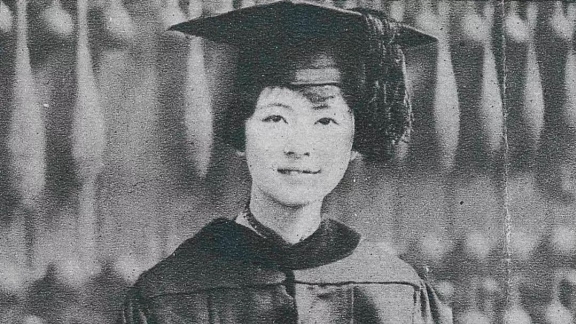
Hardships are part of growing, and that was evident through many designers we studied in this course. For instance, Lin Huiyin, who faced the challenge of being a prominent female architect in a male-dominated field, showed how perseverance shapes success.
In the second project about our future selves, it really hit me how unpredictable life can be. You don’t always know what you’re going to get. But as the saying goes:
“When life gives you lemons, make lemonade.”
It’s about taking what you have and turning it into something meaningful.
When I was in elementary school, my parents would often take me and my sister to make merit and interact with teenagers at a center for young disabled people. It was really sad to see these young individuals facing so many challenges. But at the same time, it was inspiring to see their resilience, creativity, and strength. Even though their paths were different, they still found ways to express themselves and find joy.
Reflecting back, I realize how these experiences shaped the way I view innovation today. Innovation is not just about coming up with new ideas, it’s about working through obstacles, adapting, and finding strength in uncertainty. This course reminded me that growth comes from commitment, patience, and believing in the value of your own journey, even when it feels difficult.
And perhaps most importantly, it taught me that true innovation starts from within — from the courage to believe in yourself!
Before the Saturday session, Xuchu, Echo and I spent around an hour to prepare an empathy tool for quadriplegia and we chose to focus particularly on the movement of the hand.
We ended up producing a pair of gloves that restrict the movement of our hands which made from clothes and cardboards. While wearing the gloves, we found out that it was very difficult for us to grab something.
On Saturday, we first exchanged our empathy tool with the group that was working blindness. We received a box that simulate how various kinds of blind people see the world.
Our group then came up for the three card box prototypes that focus on different aspect of blindness. Xuchu focused on preventing head injury, Echo focused on the voice navigation, and I focused on the space and sensory.
Then we switched our prototypes with the group that was working on hyperesthesia. Before we started, we put on the empathy tool and we were hurt by the empathy tool! It was very itchy and that was such a great tool because it simulate how people with hyperesthesia feel as they can be easily irritated by everything.
Among the three prototypes that we received, we decided to work on Ken’s prototype. A tool that helps a person with hyperesthesia to cook by not being too close to the stove.
Our team then decided to work on Ken’ prototype by making some adjustments to the joints of the device. We planned to make it rotatable from different angles.
Throughout the day, I noticed that our group were really tight. We didn’t individually work on the prototype and we rather wanted to work on the group. This showed that our team dynamic is very good and we preferred to help each other come with idea and refine it together. I wanted to thank Xuchu and Echo for being part of this great project that will make great impact and prepare ourselves for the future version of ourselves!
When we think about technology designed for people with disabilities, the common narrative often centers on empowerment—how devices like prosthetics or screen readers “fix” a person or help them “overcome” their disability. But what if we reframe that idea? What if, instead of trying to make disabled people conform to an ideal of normalcy, we designed the world to support the bodies they already have?
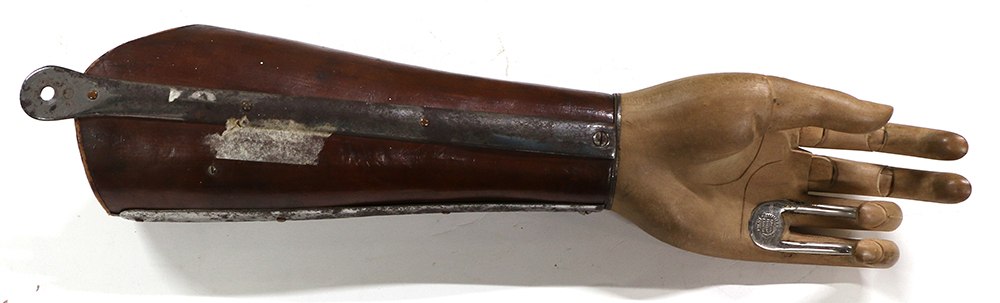
Britt was born without part of her left arm and wore a prosthesis from the time she was six months old. For nearly 30 years, she put it on every morning before going to school, because that’s what society told her was best—adapting early to the device would make life easier. But at home, she’d take it off. And it was in those hours without the prosthetic—when no one was watching—that she truly learned how to navigate the world on her own terms.
Later, during her time as a Ph.D. student in geography at UC Berkeley, Britt made the bold decision to stop wearing her prosthesis altogether. That environment, she said, gave her the safety and support to explore life as she really is—not as someone trying to fit into a mold. That choice revealed to her how many designs are not only inaccessible to people with disabilities, but also unnecessarily complicated for everyone.
Her story asks us to consider: Are we designing for disabled people or are we designing to make them less disabled in the eyes of society?
One example of helpful design: Voice-to-text software
This technology was originally developed to assist people who have limited mobility or are non-verbal. But it has broad applications. Many people now use voice-to-text on their phones while driving, multitasking, or even just for convenience. It’s a great example of inclusive design that truly benefits disabled and non-disabled users alike.
One example of problematic design: Traditional prosthetic arms
As Britt’s experience shows, prosthetic arms are often designed with an assumption of what a “normal” body should look like. But they may not actually support how a person lives in their body. Britt found her prosthetic more of a hindrance than a help. Instead of enhancing her life, it became a symbol of pressure to conform. Her choice to remove it revealed that the technology wasn’t as empowering as it claimed to be. However, it was just another way to “fix” something society thought was broken.
Britt’s story is a reminder that inclusion isn’t just about adding technology. Sometimes, it’s about subtracting assumptions and letting people move through the world in the ways that work best for them.
The goal shouldn’t be to make disabled people less disabled. It should be to make society more accommodating.
Marc Newson is a versatile Australian designer known for his ability to work across different scales and industries, from furniture and watches to aircraft interiors and space travel. His approach to design is rooted in a balance between artistic expression, functionality, and timelessness. Unlike many designers who focus on a single niche, Newson embraces a broad spectrum of projects, applying the same problem-solving logic regardless of scale or material. He is deeply influenced by his Australian upbringing, which shaped his sense of space, light, and material use. Newson values longevity in design, seeking to create objects that endure beyond trends and disposability.
“I always strive and I think I always have even from the moment that I did that to create something that would be able in a sense to live its own life, to live by itself … to strive to create a classic whatever a classic is.” — Marc Newson
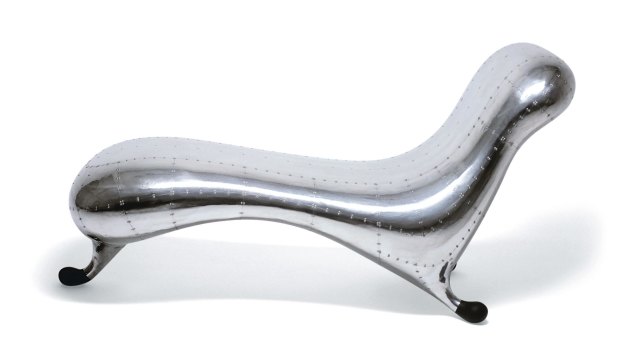
My least favorite design from Newson is Lockheed Lounge. It feels more like a sculptural statement than a functional piece of furniture. Its curvy, liquid-like shape looks futuristic, but it doesn’t seem comfortable or inviting to sit on. The riveted aluminum surface, inspired by aircraft design, gives it a cold, industrial feel that doesn’t appeal to me in a living space. While I appreciate innovative design, I prefer pieces that balance aesthetics with usability, and this one prioritizes form over function in a way that doesn’t resonate with me.
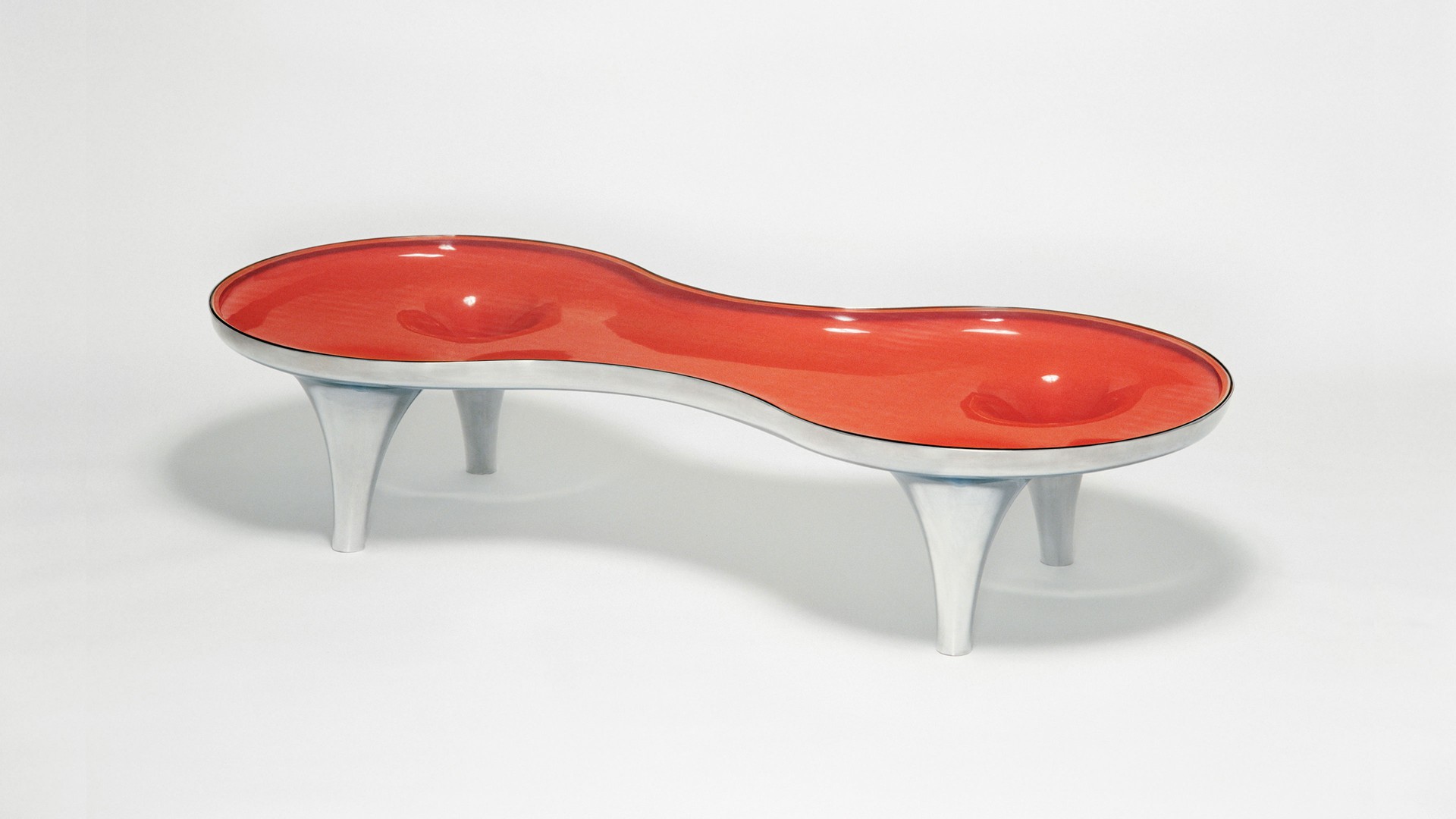
My favorite design is the Orgone Chop Top Table. Its sleek, organic form gives it a futuristic yet timeless appeal, making it a statement piece without feeling overly extravagant. I love how the curved, aerodynamic shape and polished finish create a sense of movement, almost as if the table is in motion. Unlike the Lockheed Lounge, which feels more like an art piece than usable furniture, the Orgone Chop Top Table is both visually striking and practical.
I will try to compare Newson with other designers through these three following themes: (1) Tradition vs. Futurism, (2) Function vs. Artistic Expression, and (3) Organic vs.Industrial Aesthetics
Tradition vs. Futurism
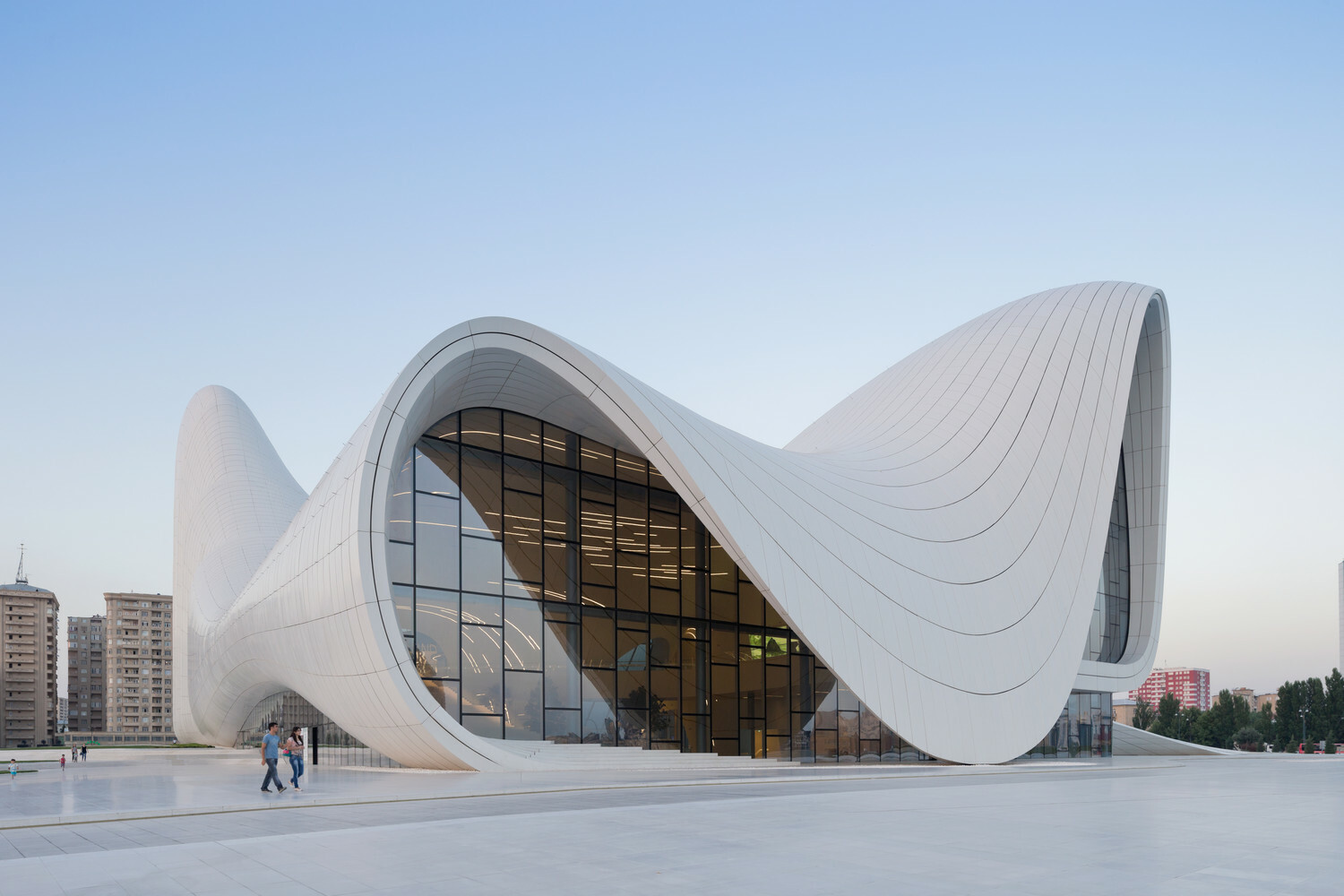
Lin Huiyin and Zaha Hadid represent two vastly different approaches to design. Lin dedicated her career to preserving and modernizing traditional Chinese architecture, ensuring that historical structures were not only documented but also adapted for contemporary use. In contrast, Hadid’s architecture completely rejects tradition in favor of sweeping, futuristic curves and fluid forms that defy expectations. Hadid’s buildings, such as the Heydar Aliyev Center, feel almost weightless, as if they belong to another era entirely. While Lin sought to bridge the past with the present, Hadid envisioned an entirely new architectural language.
Similarly, Marc Newson’s industrial designs lean heavily toward futurism and aerodynamics, much like Hadid’s approach to architecture. His Lockheed Lounge, with its smooth, riveted aluminum surface, resembles a piece of aviation engineering more than traditional furniture. Unlike Lin Huiyin, who focused on preserving cultural identity, both Hadid and Newson embrace innovation and the aesthetics of movement and speed.
Function vs. Artistic Expression
Philippe Starck and Marc Newson both work across multiple design fields, from furniture to transportation, but their philosophies diverge. Starck often prioritizes conceptual impact over function, creating pieces like the Juicy Salif lemon squeezer, which is more of a conversation piece than a practical kitchen tool. He enjoys playing with irony and provocation in design, pushing users to question the relationship between objects and daily life.
Newson, on the other hand, maintains a stronger focus on usability and craftsmanship, even while working with futuristic forms. His Orgone Chop Top Table, for example, is sculptural yet remains highly functional. While both designers experiment with form, Newson’s work feels more refined and ergonomic, whereas Starck’s can sometimes lean toward the playful and impractical.
Organic vs. Industrial Aesthetics
Hadid and Newson both embrace curvilinear forms, but their applications differ significantly. Hadid’s architecture mimics natural landscapes and flowing movement, creating structures that seem to emerge organically from their surroundings. Newson, however, draws inspiration from machinery and speed, designing objects that resemble futuristic vehicles or spacecraft. His use of high-tech materials like aluminum and carbon fiber sets him apart from Hadid’s emphasis on fluidity in large-scale architecture.
The Role of Purpose in Design
What stands out to me about these designers is how their personal philosophies shape their work. Lin Huiyin’s commitment to cultural preservation resonates deeply, as it reflects a sense of responsibility in design. Hadid and Newson, by contrast, inspire me with their boldness and willingness to break conventions, showing that great design is not only about function but also about shaping the future in unexpected ways.
Starck, while undeniably influential, feels like the most unpredictable of the four. I admire his willingness to challenge norms, but at times, his work prioritizes artistic statement over real-world usability. While I appreciate conceptual design, I personally lean toward pieces that strike a balance between beauty and function, which is why Newson’s approach resonates more with me.
Ultimately, these designers prove that great design takes many forms or pushing the boundaries of functionality. Each of them offers a different perspective on how design shapes the world, and while I find myself drawn to certain approaches more than others, I can see the value in all of their contributions.
For this week, I have tried to model my prototype based on the picture of glasses.
For this first CAD model, I mainly follow the tutorial from Week 3 Recording that Professor Joyce sent it via email. I used the function “Create Form” from the sketch to create the shape of the sketch function. Furthermore, I mainly used “Extrude” to extend the different part of the shape.
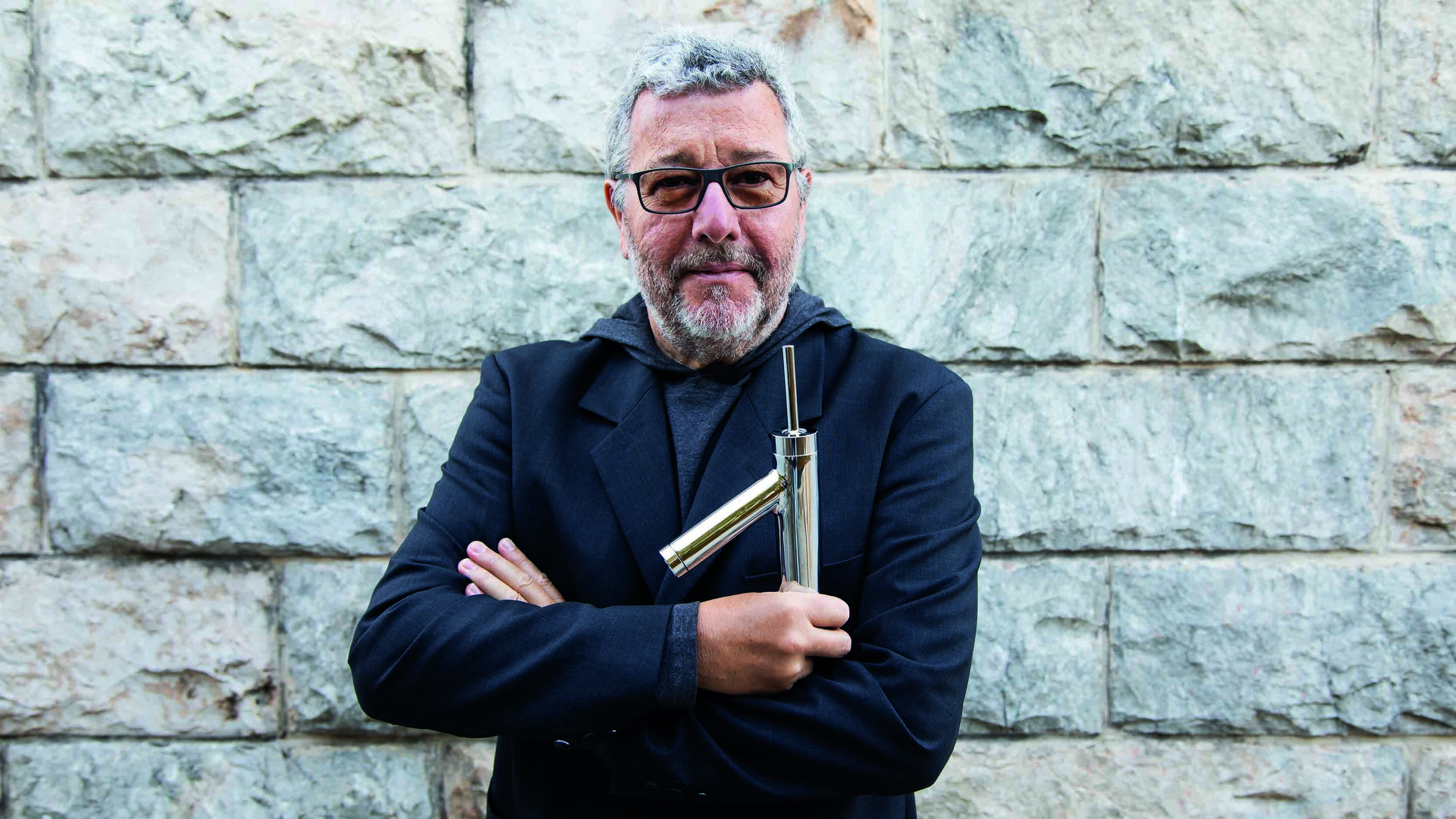
“Me, I make a job which is not very interesting. Design doesn’t save lives, perhaps design can help a better life, but doesn’t save lives. That makes clear the limit of the obsolescence of this job.” — Phillipe Starck
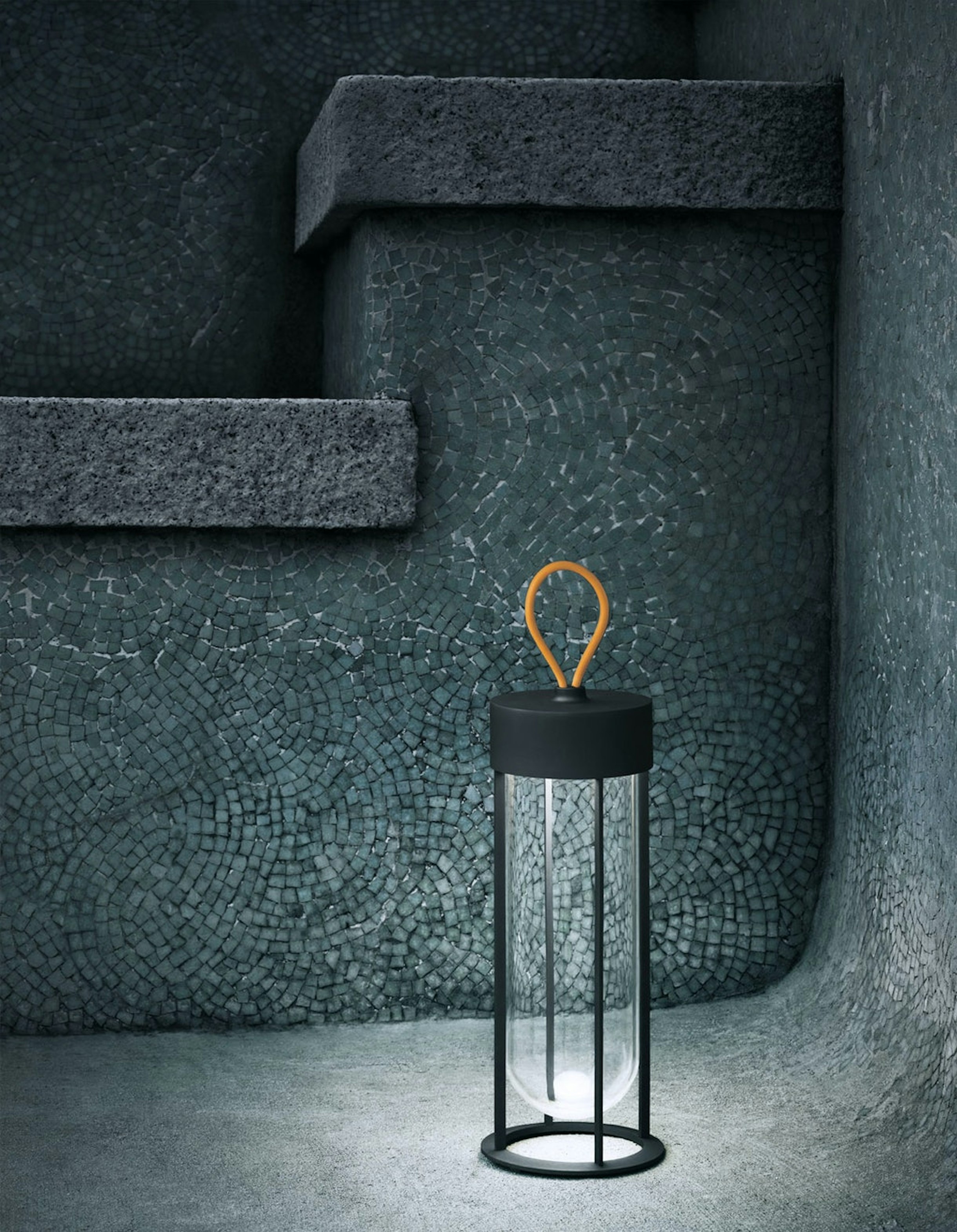
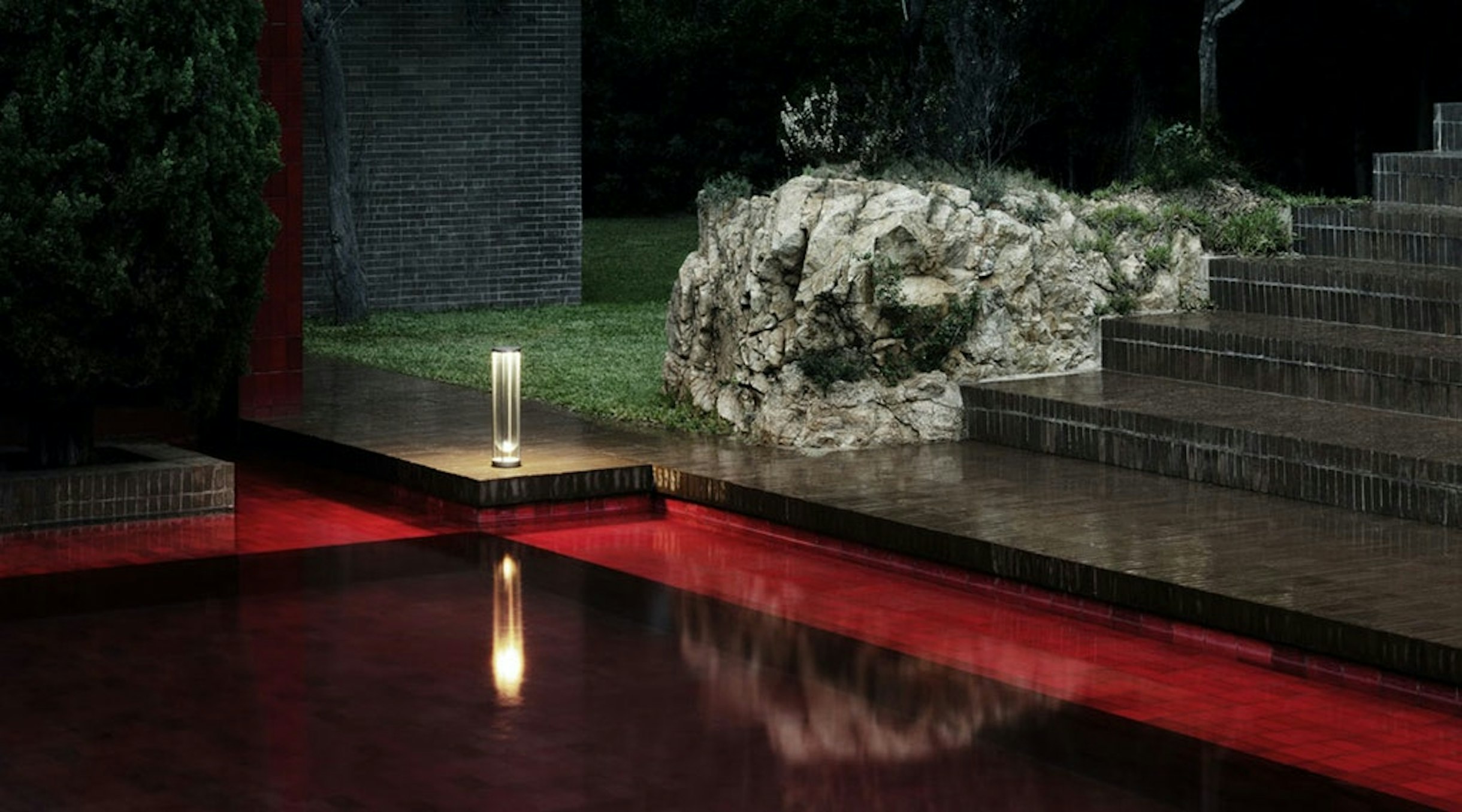
Design I liked: In Vitro
I liked the way how this glass lantern is designed. Its transparent glass structure gives the illusion of a floating light, adding elegance to any space. The design is subtle yet impactful, offering warm, diffused lighting without being overpowering. I appreciate how it seamlessly merges aesthetics and functionality, making it a refined and timeless piece.
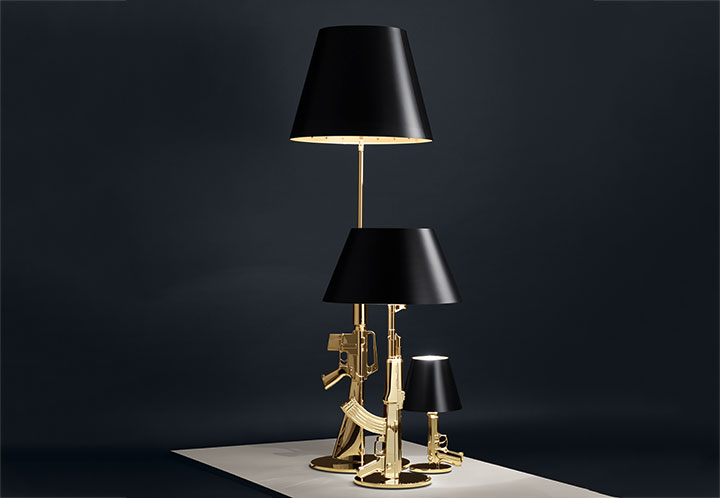
Design I disliked: The Gun Lamp
The lamps feature bases shaped like various firearms, including the Beretta pistol and the AK-47 rifle, with shades that diffuse light downward, symbolizing the direction of a bullet.Starck intended this design as a commentary on the relationship between war, money, and power. While the concept aims to provoke thought on serious global issues, the execution has been polarizing.Some view the lamps as a bold artistic statement, while others see them as glorifying violence or trivializing the impact of firearms.Personally, I find the literal incorporation of weapons into household items unsettling, as it blurs the line between functional design and the representation of instruments of harm.
Starck believes creativity isn’t random but a result of continuous refinement, questioning purpose, and adapting to change. His philosophy reminds me to prioritize deep work, embrace evolution, and ensure my projects serve a greater purpose.
Born in 1904, Lin Huiyin grew up during a period of immense change in China. The country was shifting from the imperial Qing Dynasty to the modern Republic, struggling to define its identity in the face of Western influences. Architecture, like many fields, was dominated by foreign styles, and little effort was made to preserve China’s own rich history.
Alongside her husband, Liang Sicheng, Lin embarked on an ambitious mission: to document and preserve China’s traditional architecture before modernization erased it. They traveled across the country, sketching, photographing, and cataloging ancient wooden structures—some dating back to the Tang Dynasty. Their work laid the foundation for the study of Chinese architectural history.
But it wasn’t easy. The Second Sino-Japanese War (1937-1945) forced them into exile, and later, the Cultural Revolution would threaten everything they had worked for. Yet, Lin persisted, driven by her love for art, history, and storytelling
In the 1920s, few women pursued careers in architecture, let alone in China. Lin defied the odds, studying at the University of Pennsylvania—though, as a woman, she wasn’t officially allowed in the architecture program and had to enroll in fine arts instead. Despite this, she immersed herself in the discipline, learning the principles that would later shape her career.
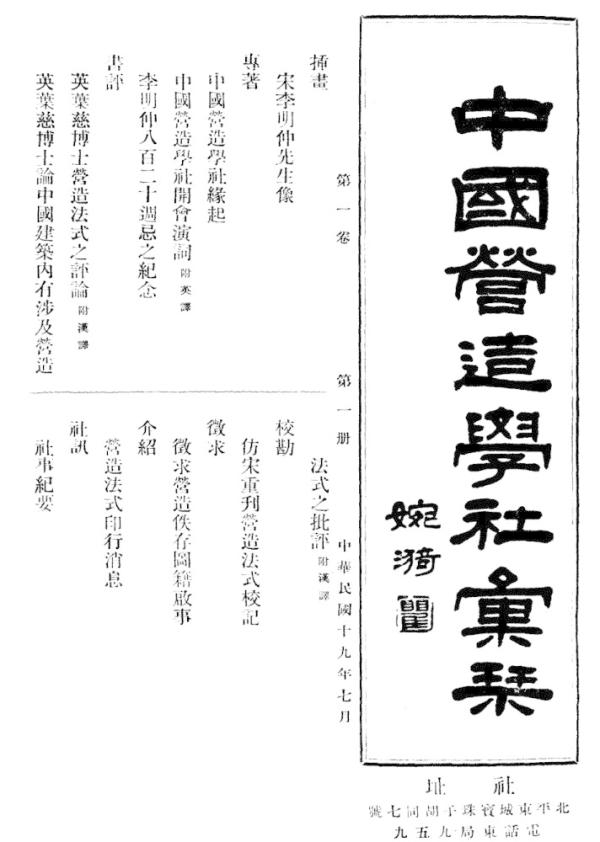
Upon returning to China, she co-founded the Society for Research in Chinese Architecture, a groundbreaking institution dedicated to the study and preservation of Chinese heritage. But even then, she was often overshadowed by her husband, with many assuming she played a supporting role rather than being an equal contributor. She proved them wrong, not just through research but by actively participating in demanding fieldwork, something even many male architects hesitated to do.
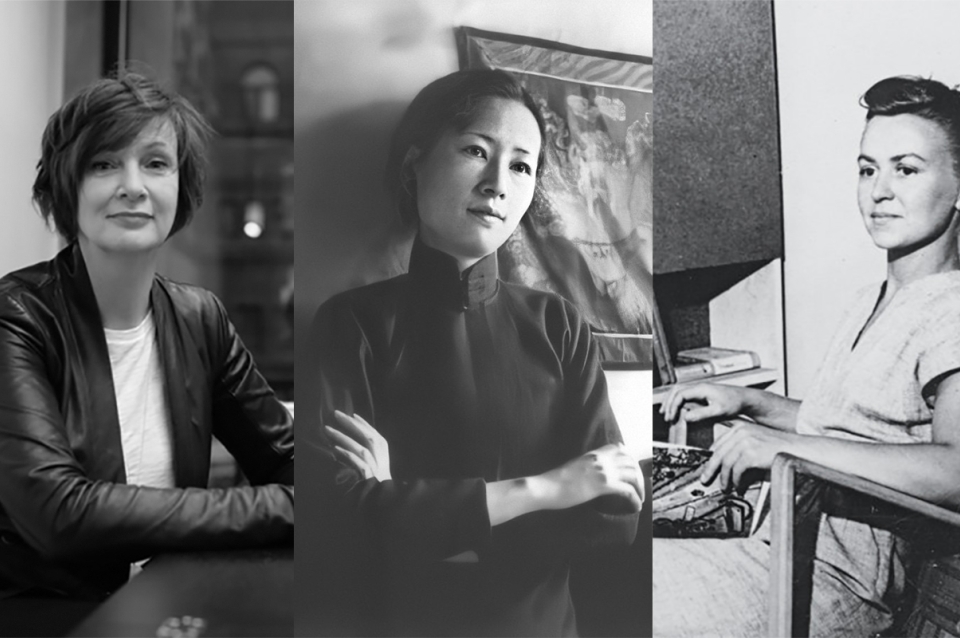
Lin Huiyin’s journey reflects a pattern seen in many pioneering female designers, including the late Zaha Hadid. Women in architecture have long faced an uphill battle, often being overlooked or having their contributions attributed to male colleagues. Many, like Lin and Hadid, had to work twice as hard to gain recognition. Their entry into the field wasn’t just about talent but about persistence in the face of rejection and doubt.
Beyond their struggles, female designers tend to bring a unique perspective to their work. Lin, as a historian, saw architecture as a means of storytelling, preserving the past for future generations. Hadid, on the other hand, saw architecture as a futuristic canvas, pushing the boundaries of what was possible. Though their approaches were different, they shared a boldness in vision and an unwillingness to conform to industry expectations.
What also stands out is their resilience. Whether facing war, political oppression, or industry bias, Lin never abandoned her mission. Similarly, Hadid, after years of being dismissed as a “paper architect,” ultimately transformed modern architecture. Their stories remind us that beyond talent, it is determination that shapes legacies.
For this week, I tried to focus on making the head-wear a little more comfortable to wear.
Here is the story board from last session:
Instead of using two pieces of paper, I decided to focus on making the head-wear more structurally stable by refining its shape and distribution of weight.
For this week, I revisited some of my ideas from Challenge 1 Week 1 Documentation and went a little bit more into the idea of mind wandering and how to stay focused.
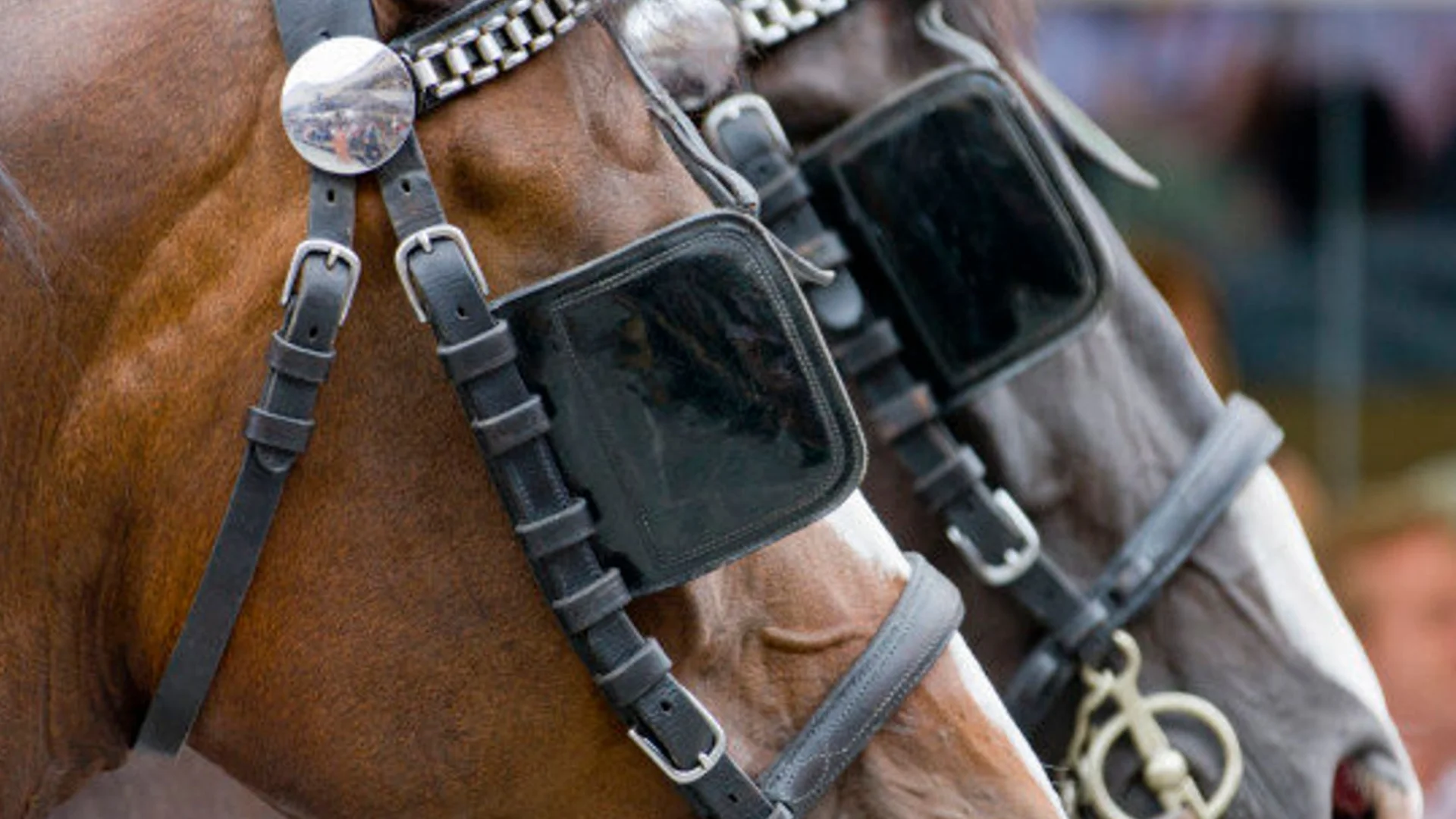
While I was having a hard time thinking what I should create for my project, I happened to meet Catherine Ward at the IMA Studio on 4th floor. Cat suggested me to take a look at the horse blinder.
Eventually, I was thinking about why don’t make a “human version” of the horse blinder as well!



 This week, I tried to put pictures of the card box model that I made into CAD model.
 Here I add an additional function to the glasses.


 I used the function “Create Form” from the sketch to create the shape of the sketch function. Furthermore, I mainly used “Extrude” to extend the different part of the shape.